Professional Cosmetics Peptide Supplier | GENOPEP



Palmitoyl Tetrapeptide-20 for Peptide Self Tanner Development
The role of PT20 in sunless tanning
Palmitoyl Tetrapeptide-20 is a cosmetic peptide discussed in pigmentation research and proposed for peptide self-tanner concepts. For skin-tanning development, its role must be established for the exact supplied material and finished formula. A peptide name or a hair-pigmentation study does not establish visible skin tanning, DHA replacement, sunscreen protection or a guaranteed result time.
Why This Ingredient Needs a Claim Reset
A self-tanner brief can contain two very different requests. The brand may want a measurable change in visible skin color, or it may want a peptide-containing body-care product with a sunless-glow positioning. Those requests overlap only when the finished formula supports both. Choosing Palmitoyl Tetrapeptide-20 does not, by itself, resolve which request the project can meet.
Palmitoyl Tetrapeptide-20 is attractive for sunless-color concepts because it connects ingredient development with pigmentation science. The risk is that this connection can become an unsupported product promise. Receptor control, genome-level support and an internal UV-defense barrier are substantially different propositions from an even-looking cosmetic glow. Each would create its own scientific and regulatory questions.
A more credible development brief separates ingredient-background science from finished-product promises. It identifies the visible outcome the brand wants, the function proposed for each component and the evidence needed to connect them. This gives formulators a question they can investigate instead of a marketing conclusion they are expected to reproduce.
For example, a launch brief promising color after one application requires a different evidence plan from a body-care brief promising a comfortable, progressively warmer-looking finish. The team should decide whether the peptide is being investigated for color itself, another skin-care endpoint or simply ingredient inclusion. Only the first two are proposed benefit hypotheses. An accurate statement that a formula contains a peptide should not be dressed up as an untested performance claim.
What the Mechanism Can Responsibly Mean
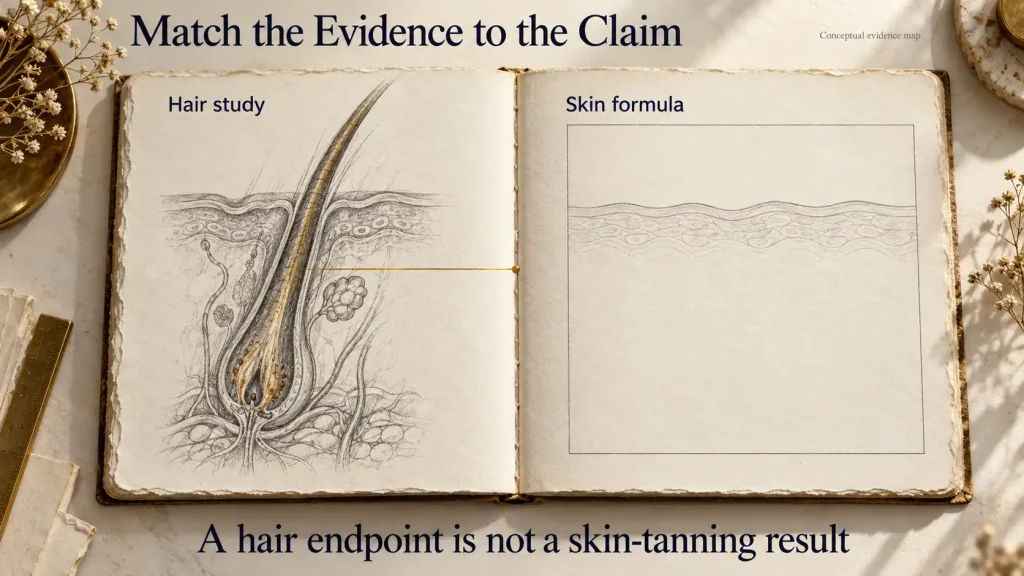
Alpha-MSH and melanocortin receptor 1, often abbreviated MC1R, provide relevant background to pigmentation research. A 2018 study described PTP20 as an alpha-MSH biomimetic and investigated hair pigmentation using laboratory models, isolated human hairs and a clinical component involving 15 men with premature hair greying. Its human observations concerned hair, not tanning of body skin. [1]
That paper provides a reason to examine the ingredient’s biological context. It does not answer whether a particular body lotion delivers the same material to the relevant skin location or produces a visible tan. Those are different questions involving the material, formulation and intended use. Shared pathway terminology cannot close that gap.
The name also needs care. Clariant’s current Greyverse page lists Glycerin, Water and Palmitoyl Tetrapeptide-20 Amide, with hair and scalp applications. A project using a material labeled Palmitoyl Tetrapeptide-20 should confirm its complete INCI and chemical identity before borrowing that proprietary product’s research. A similar name is not a substitute for a matching specification. [2]
Pairing Palmitoyl Tetrapeptide-20 with DHA
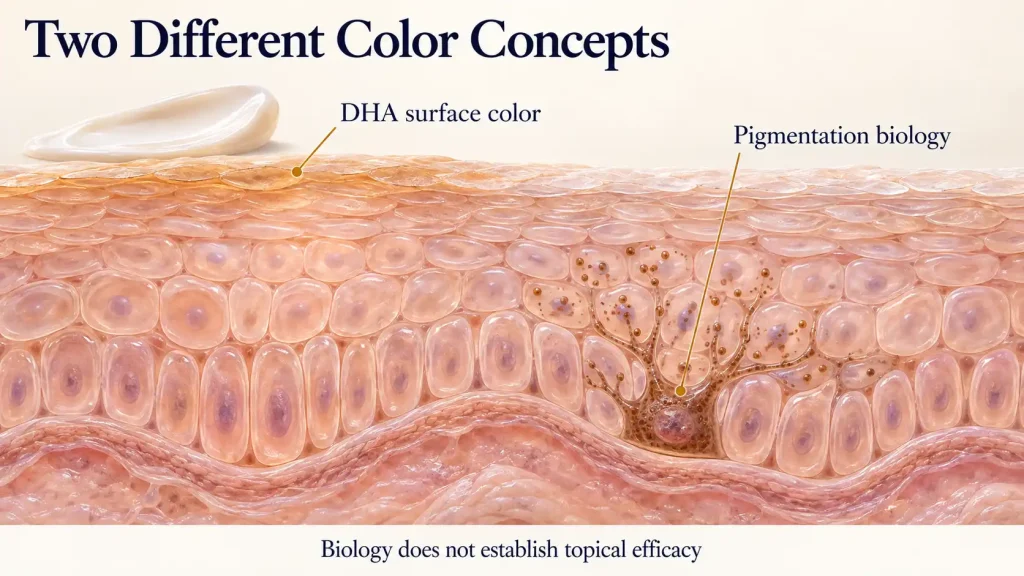
DHA provides a useful point of comparison. FDA describes it as a commonly used sunless-tanning ingredient that darkens the skin through a reaction with amino acids at the skin surface. This surface-color route should not be described as evidence that a peptide changes biological pigmentation. [3]
A formulation may be proposed with DHA for color development, humectants for application comfort and a peptide for an additional development objective. This is an allocation of proposed roles, not proof of compatibility or extra efficacy. Adding the peptide to a successful DHA base does not reveal which component caused the visible color.
Consider a brand evaluating a tinted body lotion with DHA and a peptide. Immediate warmth might come from the tint; later coloration might reflect the self-tanning system; a smoother visual finish might partly reflect the base. If the brand wants to attribute an additional benefit to PT20, it needs an appropriate comparison with the otherwise corresponding formula. A photograph of the combined product cannot assign those contributions.
Development language should follow this uncertainty. A combined prototype can be worth investigating without being described as synergistic, more stable or more effective. If the objective is a DHA-free product, removing DHA only changes one part of the brief. It does not establish that PT20 becomes the color-producing ingredient. The actual formula still has to be evaluated.
Regulatory and Documentation Checkpoints
An INCI name or an inventory entry does not establish unrestricted use or every proposed claim. In the EU, Regulation 655/2013 requires adequate, verifiable support for cosmetic claims and evidence when ingredient properties are extrapolated to a finished product. In the United States, FDA explains that intended use, including claims to affect body structure or function, can change product classification. Market-specific review belongs before launch wording is finalized. [4,5]
The first practical document is a specification that identifies what will actually enter the vessel. Confirm the full ingredient composition, peptide identity, supplied form and how content is measured. Powder purity and the concentration of a supplied solution are different descriptions. Neither, on its own, supplies a validated finished-formula use level.
Next, match each supporting study to the material and question it can answer. Record whether it evaluated a raw ingredient, a mixture, hair or skin, and whether the endpoint was a biological marker or visible appearance. A certificate of analysis answers batch-quality questions within its test scope. It is not a clinical report or a complete finished-product safety assessment.
Document gaps should change the next experiment or purchasing question. If the supplied solution’s peptide content is unclear, resolve that before comparing prototype additions. If the only available human study concerns hair, request the evidence relevant to the intended skin application rather than borrowing its outcome. If a finished-formula study exists, check whether its tested formula and use conditions match the proposed product. This avoids spending a sample budget on a comparison whose inputs or conclusions cannot be interpreted.
What Brands Should Promise
Start with the desired appearance and application experience, then decide how each will be assessed. For a gradual-tone product, useful development questions concern the size and timing of visible color change, uniformity across the intended area, fading and transfer. These are proposed evaluation topics, not results that can be claimed merely because the ingredient is present.
Application comfort deserves a separate objective. A formula can feel pleasant without changing skin color, while a visibly effective tanner can have handling problems. The peptide’s contribution, whole-formula color performance and the user’s experience should be investigated separately before they are assembled into a product story.
| Development question | Evidence to request or plan | What it does not establish |
| What material are we using? | Current identity and composition documents with batch tests | A visible skin benefit |
| Does the formula change appearance? | An appropriate finished-formula appearance study | The peptide’s independent contribution |
| Does adding the peptide matter? | A suitable matched comparison designed around the proposed benefit | A result for every vehicle or population |
| Does the product suit ordinary use? | Application, transfer, tolerability and stability evaluation | Sunscreen performance or universal safety |
When planning appearance assessment, decide what would count as a worthwhile difference before reviewing photographs. Standardize application instructions and observation conditions, and distinguish instrument readings from visual grading or user perception. A small instrument-detected change and a consumer-noticeable change answer different questions. Record the starting appearance and relevant use conditions so that an observed difference is not automatically attributed to the new ingredient. The appropriate design depends on the claim and should be set with the testing team rather than copied from an unrelated product.
Terms such as Peptide Self Tanner and Gradual Self Tanner describe a product direction, not a standard level of efficacy. Likewise, a Hyaluronic Acid Self Tanner may set a hydration objective, but the name does not prove hydration performance. A Natural DHA Self Tanner requires its own basis for the natural claim; adding a peptide does not settle that labeling question. Keep these positioning choices distinct from the tests used to substantiate them.
Sunless Color and Sun Protection Remain Separate
UV-Free Tanning should describe a proposed route to color without intentional UV exposure. It should not imply that an ingredient or the resulting color supplies SPF, DNA protection or an internal sunscreen. FDA warns that sunless tanners and bronzers without sunscreen ingredients do not protect against sunburn. [3]
For a product combining sunless color with a sunscreen claim, the team needs a separate development and regulatory assessment of sunscreen performance and the combined formula. Neither a darker appearance nor a pigmentation-pathway diagram substitutes for that work. Keep the distinction visible in the brief, the study objectives and the eventual consumer instructions.
A Practical Role for PT20
For brands, the useful question is whether the exact PT20 material helps meet a defined skin-care objective in a workable formula. Keep an experimental peptide-containing version distinct from the baseline product, set an evidence threshold before interpreting results and allow a finding of no additional benefit to influence the decision. A development project should be able to change direction when its comparison does not support the original hypothesis.
There are several legitimate outcomes of that review. The team may keep the peptide because a relevant comparison supports a useful benefit. It may continue exploratory work while withholding an efficacy claim. It may remove the peptide if the complete formula meets its target without a demonstrated additional contribution. None of these decisions should be made from the ingredient name alone. What matters commercially is whether the proposed role remains defensible when the product brief, technical documents and actual formulation are read together.
Palmitoyl Tetrapeptide-20 does not need exaggerated language to be worth evaluating. Its place in a Sunless Tanner project depends on identity, a relevant biological rationale, formulation feasibility and results that match the intended claim. Cosmetic Claim Evidence becomes useful when it answers those concrete questions rather than filling a presentation with unrelated mechanism material.
Frequently Asked Questions
1. Is Palmitoyl Tetrapeptide-20 a proven replacement for DHA?
No replacement conclusion follows from the peptide name or the cited hair study. A project seeking to replace DHA needs relevant evidence of visible skin color from the proposed finished formula. Comparisons should match the use conditions and intended endpoint rather than assume that different ingredient stories deliver equivalent results.
2. Are PT20 and Greyverse automatically interchangeable?
No. Greyverse is a proprietary ingredient with its own declared composition and evidence. Verify the exact identity and supplied form before treating another PT20 material as equivalent. Matching a short name is insufficient to transfer efficacy, handling instructions or use levels. [2]
3. Can PT20 and DHA be used in the same formula?
They can be proposed for a combined development study, but compatibility is a test question for the actual materials and base. The project should evaluate relevant ingredient integrity alongside color performance, stability and tolerability. An attractive combined concept does not establish successful coexistence in every formula.
4. How quickly should a peptide self-tanner change skin color?
A universal time cannot be assigned from the ingredient label. Define when and how the finished product will be assessed, including whether an immediate tint must be distinguished from later color development. Do not copy a hair-study schedule or a different supplier’s marketing timeline into a skin claim.
5. Will a peptide self-tanner avoid staining and replace sunscreen?
Neither conclusion follows from including a peptide. Transfer depends on the complete product and its use; it needs its own evaluation. Sunless color is separate from sunscreen performance. A formula should not be presented as providing sun protection simply because it produces a darker appearance.
CTA
If you are developing a peptide-containing body lotion or gradual-tone product, send Genopep your target market, intended application, base type, existing color system and the specific benefit you want to investigate. Include your current prototype stage and the documents your technical team needs. These details help frame a specification and sample discussion before a use level or performance claim is agreed.
Review the Palmitoyl Tetrapeptide-20 product page on Skinkind Cosmetics and send a development inquiry.
References
1. Almeida Scalvino S, Chapelle A, Hajem N, et al. Efficacy of an agonist of alpha-MSH, the palmitoyl tetrapeptide-20, in hair pigmentation. International Journal of Cosmetic Science. 2018;40(5):516-524. DOI 10.1111/ics.12494. PubMed abstract. Hair-pigmentation study; not a skin-tanning trial.
2. Clariant. Greyverse official product information. Declared composition and hair/scalp positioning; proprietary supplier information, not evidence for another supplied grade.
3. U.S. Food and Drug Administration. Sunless Tanners and Bronzers. Surface coloration and sunscreen distinction, in the US context.
4. European Commission. Commission Regulation EU No 655/2013. Common criteria for cosmetic claims, including ingredient-to-finished-product extrapolation.
5. U.S. Food and Drug Administration. Is It a Cosmetic a Drug or Both. Intended use and product classification in the United States.