Professional Cosmetics Peptide Supplier | GENOPEP



Choosing Packaging for Peptide Skincare Formulas
Choose peptide skincare packaging around the finished formula, its contact materials and the way consumers will dispense and close it. An airless pump, dropper or jar is a candidate format, not evidence that a peptide stays intact or that the product is adequately preserved. Specify the exact components, assess dispensing with the intended formula, and justify the relevant compatibility, protection and use evaluations. Ingredient storage guidance and a package supplier’s general claims cannot establish the finished product’s shelf life.
A bottle choice can arrive before the formula is ready
A brand has chosen a frosted bottle and wants a peptide serum to fit it. The laboratory sample dispenses cleanly from a simple test container. When the proposed closure arrives, the team still has to establish whether the pipette fills consistently, how the consumer returns it to the bottle, and which surfaces meet the formula. This is a development scenario, not a reported test result. It illustrates why a packaging photograph leaves important questions unanswered, even when the appearance matches the brand brief.
The Pro Peptide Solutions category at Skinkind Cosmetics provides cosmetic formulation candidates and customized peptide combinations. Confirm the exact supplied grade with Genopep before reviewing the consumer pack. The container used for an ingredient sample does not automatically become the right package for a diluted serum or a cream made with it. This article concentrates on that packaging decision rather than repeating a complete finished-product testing programme. [1]
Describe the product before comparing pack formats
Start with the formula revision that the package must hold. Record the peptide solution grade, its supplied composition and the other ingredients in the base. Include the product form, intended application and dispensing instruction. A thin serum taken out by a pipette presents a different handling problem from a cream pressed through a small outlet. The useful first question is how the actual product behaves with the candidate pack, not whether packaging for peptides has a single preferred shape.
Write down what the pack is expected to do. Perhaps the brand wants a controlled amount per actuation, a closure that is easy to replace, or protection from a sensitivity established during development. Distinguish those needs from aesthetic preferences. A requirement such as opaque white finish needs a separate explanation if it is being used to justify light protection. Agree which observations would cause the team to reject a candidate; an attractive sample should not set its own acceptance criteria after the review.
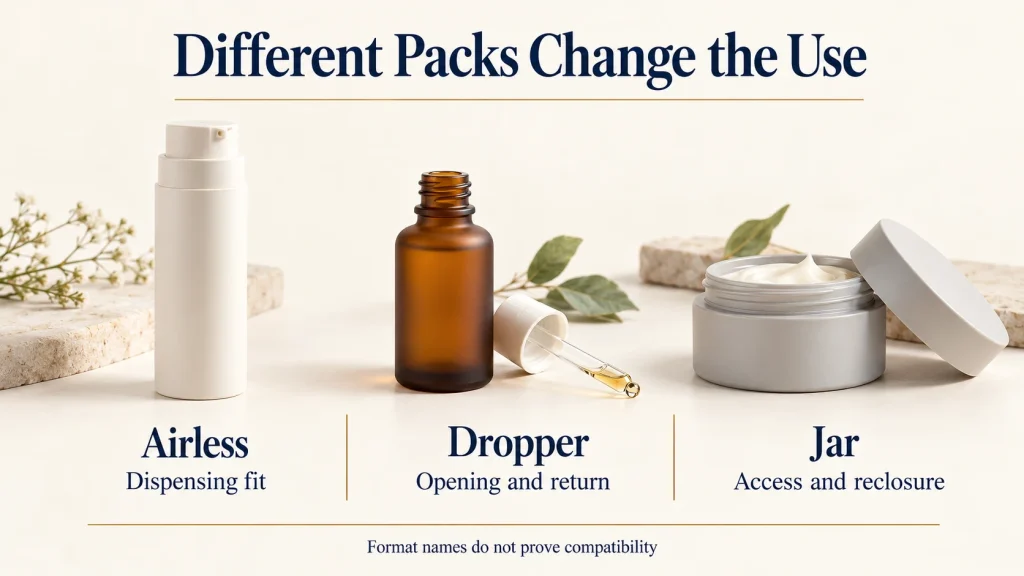
Airless pump vs dropper is a design comparison
Airless systems are not all built alike. Aptar Beauty describes designs using a piston or a bag within a bottle to move product toward the dispenser. That explanation identifies a dispensing architecture; the manufacturer’s broader protection and evacuation statements remain product-specific supplier claims. Request the construction and performance information for the actual model under consideration. An ordinary bottle with a press head should not be assumed to have the same internal arrangement as an airless design. [2]
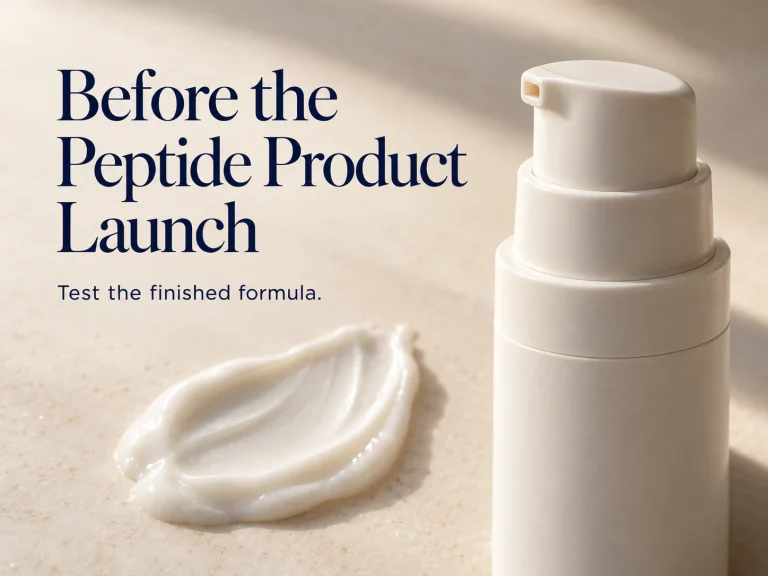
For the airless pump vs dropper comparison, review actions as well as appearance. With a pump, consider priming, the amount dispensed, outlet residue and performance as the pack empties. With a pipette, examine withdrawal, the amount picked up, dripping and return to the bottle. These are proposed evaluation questions, not reasons to declare one format superior. A package may be mechanically convenient while leaving its formula-contact or protective performance unresolved. Keep those findings separate in the decision record.
For peptide cream packaging, an open jar adds a different access and reclosure task. Describe whether the intended use involves fingers or a separate applicator, and how the lid is replaced. FDA notes that finger contact can introduce microorganisms into a cosmetic. That is relevant background for the use assessment, not evidence that every jar is unsafe or that every pump is adequately protected. The formulation and its preservation assessment still matter. [7]
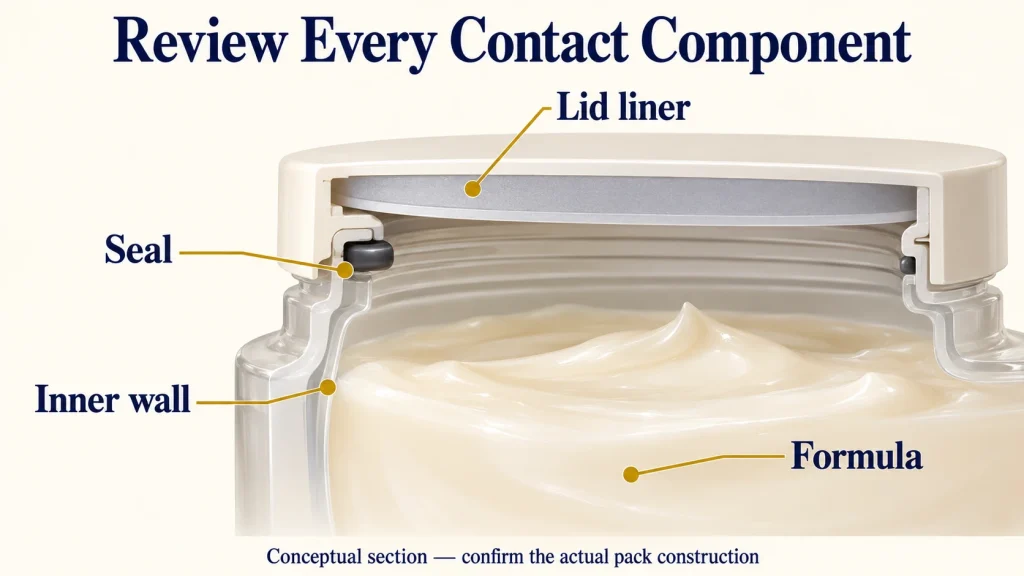
Review the surfaces inside the assembled pack
The visible bottle is only part of cosmetic packaging compatibility. Ask which components contact the product during filling, storage and dispensing. Depending on the design, these may include an inner wall, liner, seal, tube or valve. A metal spring visible in a drawing may or may not enter the product-contact path; establish that from the actual construction. Review the assembled package rather than assigning compatibility from the outer shell’s material name.
European Commission guidance on the cosmetic safety report identifies direct-contact packaging information as relevant to assessment. It discusses interactions, barrier properties and migration, while distinguishing hazard information from the assessor’s risk evaluation. Useful information from similar combinations does not establish every new formula and pack. This is a regulatory assessment context, not a universal migration-test recipe or evidence that a particular material necessarily harms peptides. [3]
Cosmetics Europe’s packaging advisory document provides an information-exchange approach for safety assessment, with a focus on possible migration. It expressly does not supply detailed methods for technical performance or formula-specific stability. Ask the packaging supplier to identify the relevant material grades and components, then involve the qualified reviewer in deciding what information or investigation is needed. A generic declaration should not silently become proof of the assembled pack’s suitability for a new formula. [4]
Treat light and air protection as specific requirements
If development has identified a relevant light or air sensitivity, describe it precisely and ask what the candidate pack can address. European Commission guidance calls for appropriate packaging when such sensitivity affects product safety or efficacy. It does not say all peptides require the same barrier. The other ingredients and the complete formulation can also determine the requirement. Keep ingredient-specific guidance attached to the exact supplied material rather than extending it to every formula containing a peptide. [3]
An amber colour, frosted finish or opaque decoration is a visual description. Ask for evidence relevant to the protective property being relied on, including the complete bottle and closure. Also establish whether the consumer keeps the product in its carton. A carton can be part of a storage arrangement without describing what happens after removal. Do not translate a marketing word such as protective into a measured barrier value, or assume an airless name means zero oxygen exposure throughout the product’s life.
Evaluate what reaches the consumer
For peptide serum packaging, inspect dispensing with the intended formula and closure rather than with water alone. Record the conditions of the review and how the pack was filled. If product is difficult to withdraw, spits from the outlet or remains inaccessible near the end, document the observation before attributing it to the peptide. The dispenser, rheology and filling arrangement deserve investigation. A smooth laboratory sample does not answer how the assembled package behaves after storage and repeated use.
When the use instruction specifies an amount, establish how dispensing relates to that instruction. A supplier’s nominal output is a starting point for discussion, not the amount demonstrated with every formula. Compare observations across the relevant stages of use under agreed conditions. This does not call for a universal numerical dose limit. It calls for evidence appropriate to the product’s instruction. Consistent dispensing alone still cannot establish peptide content, skin delivery or a cosmetic efficacy claim.
Separate unopened storage from repeated use
A sealed pack on a shelf and an opened pack used repeatedly answer different questions. Define which condition an evaluation represents. Include intended handling and reclosure in the assessment, with reasonable foreseeable use reviewed by the responsible team. ISO 11930’s public scope addresses assessment of a cosmetic product’s antimicrobial protection through preservation efficacy data, microbiological risk assessment or both. It does not turn the name of a package format into a preservation result. Consult the applicable method and qualified laboratory for the actual product. [6]
Ingredient expiry information concerns the supplied material under its defined conditions. The serum or cream has a different composition and consumer-use history. FDA describes cosmetic shelf life as depending on product type, storage and use, and places responsibility for determining it with the manufacturer. Do not borrow a raw-material expiry or a familiar period-after-opening symbol to fill an artwork gap. Durability and labelling need a product-specific basis and review for the intended market. [7]
Make the comparison useful before ordering decoration
Choose evaluations around the unresolved packaging questions. ISO/TR 18811’s public abstract offers a stability-assessment framework, while leaving methods, conditions and criteria to the manufacturer’s justification. It supplies no universal storage schedule for peptide cosmetics. A review plan should identify the tested formula, actual pack components, filling state, relevant storage or use conditions, observations and decision criteria. Record what is omitted so that a short screening exercise cannot be mistaken for a complete launch assessment. [5]
Keep mechanical, formula and safety findings distinguishable. A leak observation, a dispensing complaint and a suspected chemical change do not have the same meaning or investigation route. Photograph visible differences, retain component identification and record the product history. If intact peptide identity or content is relevant, discuss an appropriate analytical approach with the laboratory. Colour and pH observations can describe the formula, but cannot alone resolve that question or prove a suspected packaging interaction.
A useful comparison also holds the formula and sample history steady where possible. If one candidate contains freshly made serum and another contains an older batch, a difference cannot confidently be assigned to the pack. State the comparison design and relevant differences before interpreting observations. When several factors change together, identify the resulting limitation and decide whether another comparison is needed. This prevents a hurried screening table from attaching a packaging explanation to a difference that the trial was not designed to isolate.
| Decision area | Information to retain | Question to resolve |
| Formula contact | Actual component materials | Which surfaces contact the product |
| Dispensing | Formula and use observations | Does the pack support the instruction |
| Protection | Evidence for the stated need | What property has been demonstrated |
| Storage and use | Represented conditions | Which product histories remain open |
| Repeat supply | Component revision and change notice | Does a later pack match the reviewed one |
Keep the approved pack identifiable
Before committing to decoration, agree how development samples relate to the components that will be purchased. A prototype made from a different material or closure can help discuss appearance without representing the final product-contact construction. Ask which features are representative and which remain provisional. Record that status in the review rather than calling the prototype approved packaging. If a late production constraint requires a change, bring the changed component back to the relevant reviewers before assuming that the earlier assessment still covers it.
Freeze the component set that was actually reviewed. Retain supplier codes, material details, drawings where available, decoration and closure identification alongside the formula revision. A later change to a liner, pump, wall construction or filling arrangement should trigger a review of its significance. Similar appearance is an unreliable change-control record. The procurement team needs to know which substitutions are allowed and who can approve them before a component shortage leads to an undocumented replacement.
If a refill or reuse option is proposed, treat the changed handling as another development question. Establish what the consumer removes, cleans, transfers and closes, and which parts are retained. A refill concept may need a different review from an unopened disposable pack. Environmental positioning also needs its own support; neither a lighter object nor a reusable appearance proves an overall environmental advantage. Keep that discussion separate from peptide stability and formula-contact suitability.
Frequently Asked Questions
1. Is an airless pump always best for peptide skincare?
No universal winner is established here. Confirm the specific construction, formula fit and intended protective performance. Assess the relevant product and use conditions. The word airless does not prove compatibility, peptide integrity or an acceptable shelf life.
2. Can a peptide serum use a dropper bottle?
It can be a development candidate. Evaluate the actual pipette and closure with the formula, including withdrawal and return during use. Establish the relevant compatibility and protection evidence instead of approving or rejecting the format from its appearance alone.
3. Does amber glass prove light protection?
Its colour does not establish the protection required by a particular formula. Ask for relevant information for the complete pack and assess it against the identified sensitivity. Keep any carton-dependent arrangement distinct from use after the carton is removed.
4. Can packaging replace preservation assessment?
A protective design may be relevant to a product’s risk assessment, but it does not establish preservation performance by itself. Review the formulation, manufacturing and intended use with the microbiology team. Do not assume every pump is protected or every jar is unsuitable. [6,7]
5. Does a peptide solution shelf life transfer to the finished cream?
No. The finished formula, consumer pack and use conditions differ from the supplied ingredient. Establish the product’s durability and labelling basis from relevant evidence and market review, rather than carrying over the ingredient’s expiry. [7]
Discuss the formula and pack together
Review Pro Peptide Solutions for a cosmetic formulation candidate, then send the product and packaging brief to Genopep. Include the evaluated grade, base revision, product form, intended pack and use instruction, plus the packaging questions still unresolved. Ask Skinkind Cosmetics for current ingredient-specific information; coordinate assembled-pack review with the packaging supplier and qualified testing or safety team. Ingredient selection and package approval are related decisions with different supporting evidence. [1,8]
References
1. Skinkind Cosmetics — Pro Peptide Solutions. Cosmetic formulation candidates and customized combinations, not consumer-pack validation.
2. Aptar Beauty — Airless Packaging. Manufacturer explanation of piston and bag systems; protection claims remain supplier- and model-specific. 。
3. European Commission — Decision 2013 674 EU. Cosmetic safety-report guidance on direct-contact packaging, interactions, barriers and assessment.
4. Cosmetics Europe — Packaging Advisory Document June 2019. Safety-information exchange; not a formula-specific technical stability protocol.
5. ISO — ISO TR 18811 2018 Public Abstract. Stability-assessment framework without universal test conditions or criteria.
6. ISO — ISO 11930 2019 Public Scope. Antimicrobial protection through preservation efficacy and risk assessment; consult applicable amendments and methods.
7. US FDA — Shelf Life and Expiration Dating of Cosmetics. Storage, use and manufacturer responsibility for cosmetic shelf life.
8. Skinkind Cosmetics — Contact Us. Ingredient and technical enquiry route.