Professional Cosmetics Peptide Supplier | GENOPEP



Exosomes, Growth Factors, and Peptides: What Brands Should Know Before Formulating
Why Exosome Skincare Is Getting Attention
Exosome skincare has become one of the most searched regenerative-beauty ideas because it sounds advanced: cell communication, extracellular vesicles, growth-factor-like signaling, and post-procedure skin recovery. For a brand team, that language can attract attention fast. For a formulator or buyer, it also raises a harder question: can this story be turned into a stable, well-documented, cosmetic product without borrowing medical claims?
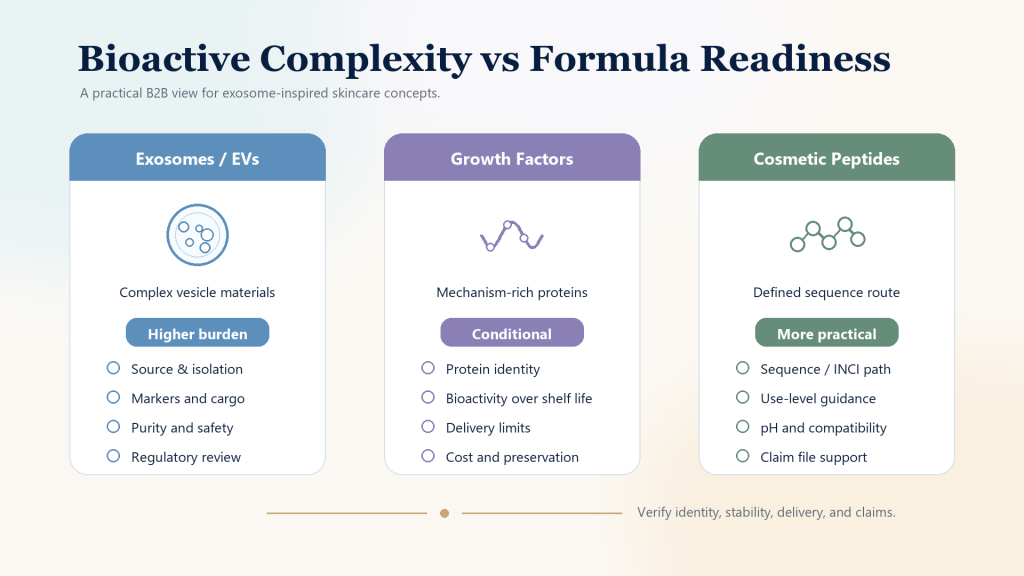
The short answer is: exosomes are a powerful concept, growth factors are a mechanism-rich comparison, and peptides are often the more formulation-ready route. A good B2B article should not flatten these three into the same “bioactive” bucket. They differ in identity, batch control, stability, delivery expectations, documentation burden, and claim risk.
Exosomes Are Not a Simple Cosmetic Active
In scientific use, exosomes are a subtype of extracellular vesicles, and modern EV research expects careful reporting of source, isolation, characterization, purity, markers, cargo, and functional testing. The MISEV2023 guidance exists because extracellular vesicle research is complex and easy to over-interpret. That same complexity matters when a skincare supplier says a material is “exosome-derived” or “exosome-inspired.”
Recent dermatology reviews describe possible benefits and challenges of exosomes in cosmetic dermatology, and systematic reviews are beginning to collect early evidence for topical exosome and peptide approaches. However, early evidence is not the same as a clear cosmetic formula file. Brands should separate in-clinic regenerative medicine language from daily topical product language, especially in markets where exosome products are watched closely by regulators.
Growth Factors Add Mechanism, but Also Formulation Demands
Growth factors sit in the middle of the conversation. They help explain why consumers associate exosomes with repair and renewal, because many exosome stories imply signaling molecules, proteins, and growth-factor-like activity. Yet growth factors are large, delicate proteins compared with small cosmetic peptides. They can raise questions about stability, bioactivity over shelf life, preservation, packaging, cost, and the exact evidence needed for a cosmetic claim.
This does not make growth factors irrelevant. It simply means a growth-factor-led story needs stronger technical discipline. A buyer should ask which growth factor is being used, whether it is recombinant or conditioned-media-derived, how the active is quantified, how stability is protected, and whether the claim is appearance-based rather than therapeutic.
Where Peptides Fit the Exosome Trend
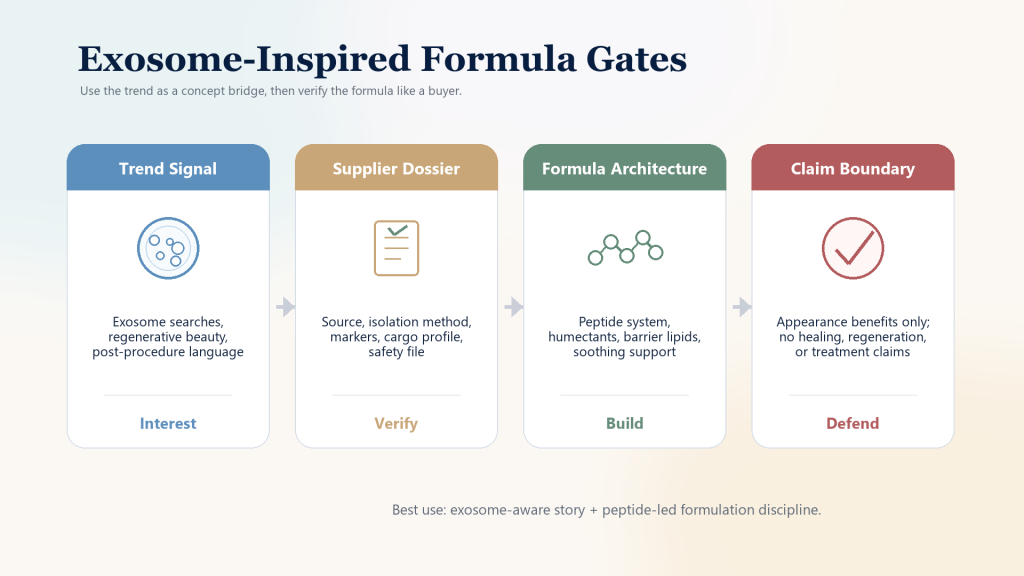
Cosmetic peptides can give brands a practical bridge between trend language and formula reality. Peptides are not exosomes, and they should not be marketed as exosome substitutes. Their advantage is different: a peptide can usually be defined by sequence, modification, INCI direction, active content, recommended use level, pH range, solubility, and compatibility notes. That makes it easier to build a development file around a serum, cream, mask, neck product, eye product, or recovery-inspired routine.
For Genopep customers, this is where single cosmetic peptides and multi-peptide formulation solutions become useful. A brand can use the exosome conversation as the consumer-interest hook, then formulate with peptide systems that support cosmetic language such as smoother-looking texture, hydrated comfort, firmer-looking appearance, barrier-support positioning, or post-stress skin comfort. The result is less sensational than “exosome regeneration,” but far easier to defend with a responsible claim file.
What Brands Should Ask Before Formulating
If a supplier presents an exosome or growth-factor ingredient, ask for source material, processing method, characterization, identity markers, impurity controls, safety documentation, preservation compatibility, stability data, and the exact claim evidence. If a supplier presents a peptide ingredient or peptide solution, ask for sequence or identity information, active content, solvent system, recommended use level, pH and temperature guidance, compatibility notes, and evidence for the proposed cosmetic benefit.
Also ask what the formula will actually say. “Supports healthier-looking skin after environmental stress” is a different claim from “regenerates damaged tissue.” “Helps skin feel smoother and more comfortable” is different from “heals inflammation.” The first group belongs in cosmetic development. The second group belongs in a much higher evidence and regulatory category.
Bottom Line for B2B Product Teams
Exosome skincare is a useful trend to watch, but it is not a shortcut around formulation science. Growth factors add a sophisticated mechanism story, but they also increase stability and documentation demands. Peptides offer a more defined way to build topical cosmetic concepts around visible skin quality, comfort, and appearance support. If your team is planning an exosome-aware or growth-factor-inspired peptide formula, Genopep can help you evaluate single peptides and multi-peptide solution concepts. Request a Quote with your target format, claim direction, and market requirements.
References
1. Haykal D, Wyles S, Garibyan L, Cartier H, Gold M. Exosomes in Cosmetic Dermatology: A Review of Benefits and Challenges. Journal of Drugs in Dermatology, 2025. DOI: 10.36849/JDD.8872. https://pubmed.ncbi.nlm.nih.gov/39761139/
2. Ash M, Zibitt M, Shauly O, Menon A, Losken A, Gould D. The Innovative and Evolving Landscape of Topical Exosome and Peptide Therapies: A Systematic Review of the Available Literature. Aesthetic Surgery Journal Open Forum, 2024. DOI: 10.1093/asjof/ojae017. https://pubmed.ncbi.nlm.nih.gov/38633728/
3. Welsh JA et al. Minimal information for studies of extracellular vesicles (MISEV2023): From basic to advanced approaches. Journal of Extracellular Vesicles, 2024. DOI: 10.1002/jev2.12404. https://pubmed.ncbi.nlm.nih.gov/38326288/
4. Alzahrani A et al. Exosomes in Skin Rejuvenation: Systematic Review of Anti-Aging Effects and Clinical Applications. Dermatology Practical & Conceptual, 2026. DOI: 10.5826/dpc.1601a6462. https://pubmed.ncbi.nlm.nih.gov/41912205/
5. Hee CK, Slade HB, Lynch SE. Safety of Exogenous Recombinant Human Platelet-Derived Growth Factor-BB (rhPDGF-BB) for Medical and Cosmetic Applications: A Review. Journal of Cosmetic Dermatology, 2026. DOI: 10.1111/jocd.70636. https://pubmed.ncbi.nlm.nih.gov/41472395/
6. FDA. Consumer Alert on Regenerative Medicine Products Including Stem Cells and Exosomes. https://www.fda.gov/vaccines-blood-biologics/consumers-biologics/consumer-alert-regenerative-medicine-products-including-stem-cells-and-exosomes
7. FDA. Cosmetics Labeling Claims. https://www.fda.gov/cosmetics/cosmetics-labeling/cosmetics-labeling-claims
8. European Commission. Commission Regulation (EU) No 655/2013 laying down common criteria for cosmetic product claims. https://health.ec.europa.eu/publications/commission-regulation-6552013_en
9. Cosmetics Europe. Guidelines for Cosmetic Product Claim Substantiation. https://cosmeticseurope.eu/wp-content/uploads/2024/10/Guidelines_for_Cosmetic_Product_Claim_Substantiation.pdf