Professional Cosmetics Peptide Supplier | GENOPEP



Copper Peptide Is Back: Formulation Notes for GHK-Cu Serums
Copper peptide is back because it offers something rare in skincare marketing: a visible blue identity, a biotech-sounding ingredient story, and enough research history to feel more substantial than a seasonal claim. For B2B skincare teams, that attention is useful, but it also raises the bar. A GHK-Cu serum cannot rely on color alone. It has to be formulated, documented, and claimed like a serious cosmetic product.
The current trend did not appear in isolation. Recent beauty coverage has placed copper peptides inside the wider 2026 conversation around skin longevity, barrier-friendly actives, and more mechanism-led skincare. Vogue has described copper peptides as an anti-aging ingredient gaining momentum, and its 2026 trend coverage also points to peptides as part of a shift away from vague glow language toward more transparent, science-forward skin-quality stories. That is exactly why brands are asking about blue peptide serums again.
What formulators should clarify first is identity. GHK is the tripeptide glycyl-l-histidyl-l-lysine. GHK-Cu refers to its copper complex, commonly discussed in cosmetics under the INCI name Copper Tripeptide-1. Those labels are close, but they are not interchangeable for purchasing or quality review. A supplier discussion should clarify the ingredient form, solvent system, active content basis, assay method, and whether the customer is buying a single peptide, a pre-diluted solution, or a broader peptide complex.
The evidence story is promising but should be handled carefully. A 2018 review in the International Journal of Molecular Sciences summarizes research on GHK and GHK-Cu, including discussion of collagen, glycosaminoglycans, skin appearance, and several small clinical studies. That literature gives cosmetic teams a scientific direction, not a free pass to make medical claims. In a website article, product page, or sales deck, it is safer to translate the story into appearance language: smoother-looking texture, firmer-looking skin, hydrated feel, and support for healthy-looking skin.
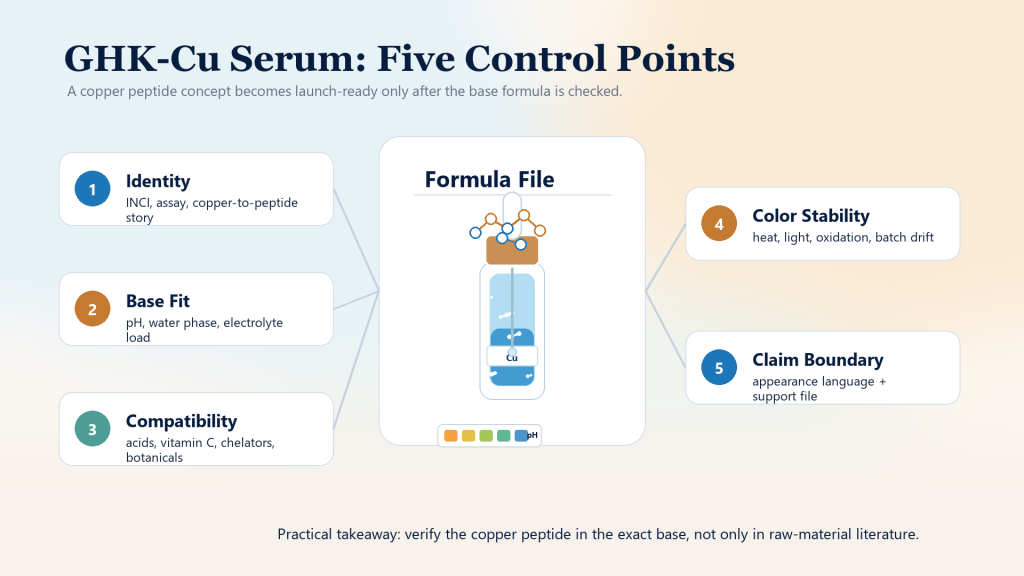
Color is another reason copper peptide serums sell well, and another reason they need discipline. A blue serum photographs beautifully and quickly signals “copper peptide” to consumers. But color is not proof of performance, and it can become a quality risk if it drifts during storage. Development teams should monitor color, odor, viscosity, pH, microbial robustness, and any active marker available under accelerated and real-time conditions. The bluer-looking formula is not automatically the better formula.
Compatibility should be screened in the actual base, not assumed from ingredient reputation. Copper-containing systems may be affected by pH, chelators, highly reactive antioxidants, oxidizing or reducing ingredients, strong acid systems, botanical extracts, fragrance components, and high electrolyte levels. This does not mean GHK-Cu cannot be combined with other modern actives. It means the combination should be tested before the concept is promised to a customer, investor, or retailer.
A practical GHK-Cu serum usually starts with a clear formulation brief. What is the target skin feel: watery ampoule, cushiony serum, or light gel? Is the brand building a premium blue-serum identity or a quieter barrier-support formula? Which supporting ingredients are required: humectants, panthenol, niacinamide, mild film formers, ceramides, or other peptides? The best answer often comes from the whole formula architecture rather than from a single headline ingredient.

Packaging also matters. Clear glass can make the blue story more visible, but light exposure, headspace, dropper contact, and decoration compatibility should be reviewed. Airless pumps, tinted packaging, controlled fill volume, and an appropriate preservative system may be better choices depending on the formula. For a B2B buyer, packaging is not only an aesthetic decision; it is part of the stability plan.
Claim review is where many copper peptide concepts become risky. The U.S. FDA explains that products intended to diagnose, cure, mitigate, treat, prevent disease, or affect the structure or function of the body may be regulated as drugs rather than cosmetics. That matters when brands are tempted to use wound-healing, tissue-regeneration, or collagen-repair language. A responsible cosmetic article can discuss the science, then keep product claims anchored in appearance, sensory benefits, and documented cosmetic testing.
For Genopep, the strongest B2B angle is not simply “we have copper peptide.” It is peptide-to-formula support: helping a brand decide whether to use a single Copper Tripeptide-1 material, a ready-to-use peptide solution, or a multi-peptide system designed around firmness look, comfort, and skin-quality positioning. That is where supplier value becomes visible to formulators and purchasing teams.
If you are developing a blue peptide serum, start the conversation with the formula file rather than the label claim. Ask for identity information, recommended use guidance, compatibility notes, stability support, and claim boundaries. Genopep can support single cosmetic peptides and peptide solution concepts for GHK-Cu serum projects. Request a Quote to discuss the peptide route, target base, documentation needs, and launch timeline.
References
- Vogue. The Benefits of Copper Peptides For Anti-Aging, Explained. Published December 23, 2025. https://www.vogue.com/article/copper-peptides
- Vogue. 2026’s Biggest Skincare Trends to Try Now. Published 2025. https://www.vogue.com/article/2026s-biggest-skincare-trends-to-try-now
- Pickart L, Margolina A. Regenerative and Protective Actions of the GHK-Cu Peptide in the Light of the New Gene Data. International Journal of Molecular Sciences. 2018;19(7):1987. https://www.mdpi.com/1422-0067/19/7/1987
- U.S. FDA. Is It a Cosmetic, a Drug, or Both? Content current as of September 11, 2024. https://www.fda.gov/cosmetics/cosmetics-laws-regulations/it-cosmetic-drug-or-both-or-it-soap
- Genopep. About Us – Professional Cosmetics Peptide Supplier. https://www.skinkindcosmetics.com/about-us/