Professional Cosmetics Peptide Supplier | GENOPEP



Voltage-Gated Calcium Channels: The Gatekeepers of Presynaptic Neurotransmitter Release
Ion Flux and Action Potential Propagation
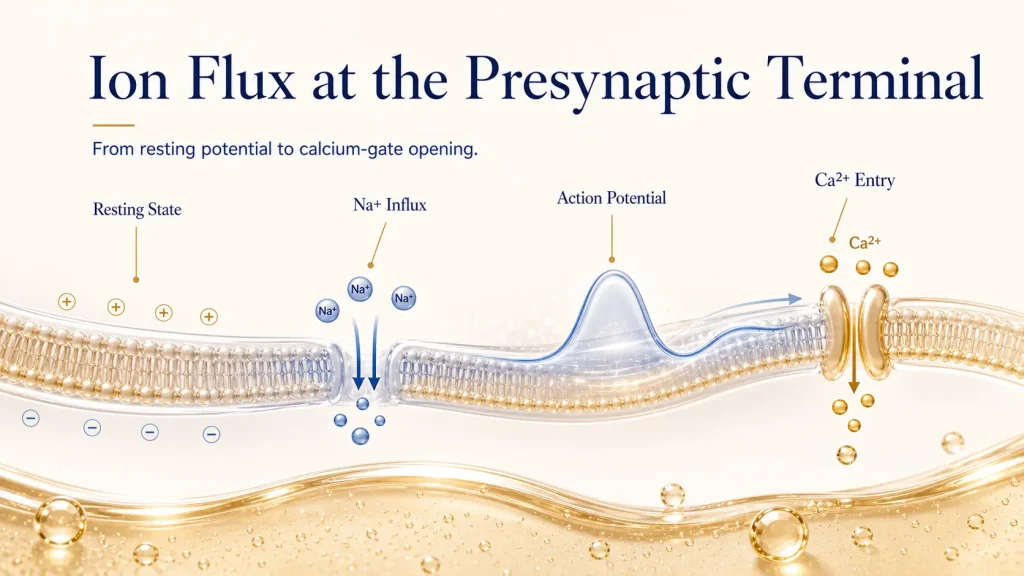
The baseline mechanics of neuromuscular transmission rely on electrochemical gradients maintained across the neuronal plasma membrane. In a resting state, a motor neuron exhibits a negative resting membrane potential, commonly around -70 mV to -80 mV. This polarized state is supported by the sodium-potassium pump (Na+/K+-ATPase), an ATP-dependent transporter that extrudes three Na+ ions for every two K+ ions it imports. Together with potassium leak channels, this process helps maintain a steep chemical gradient, leaving sodium more concentrated outside the cell and potassium more concentrated inside the cytoplasm.
When a cognitive or reflex stimulus triggers a nerve impulse, voltage-gated sodium channels open and allow rapid Na+ influx, shifting the local membrane polarity from negative toward positive. This depolarization propagates down the axon as an action-potential wave. When the wave reaches a presynaptic nerve terminal, voltage-gated calcium channels (VGCCs), including N-type (Cav2.2) and P/Q-type (Cav2.1) channels, can respond to the changing electrical field by opening selective pores. Because extracellular Ca2+ levels are far higher than resting intracellular levels, calcium ions enter the presynaptic terminal rapidly once the channel opens.
This localized calcium entry is important because it helps trigger synaptic-vesicle activity. Calcium can bind to vesicle-associated proteins such as synaptotagmin-1, supporting the docking and fusion events that release acetylcholine (ACh) into the synaptic cleft. In cosmetic ingredient education, this biology is useful as mechanism context for expression-line appearance. It should not be presented as a promise that a topical product can control nerves, stop neurotransmission, or prevent wrinkles at a medical level.
The Mechanism of Peptide-Influenced Channel Modulation
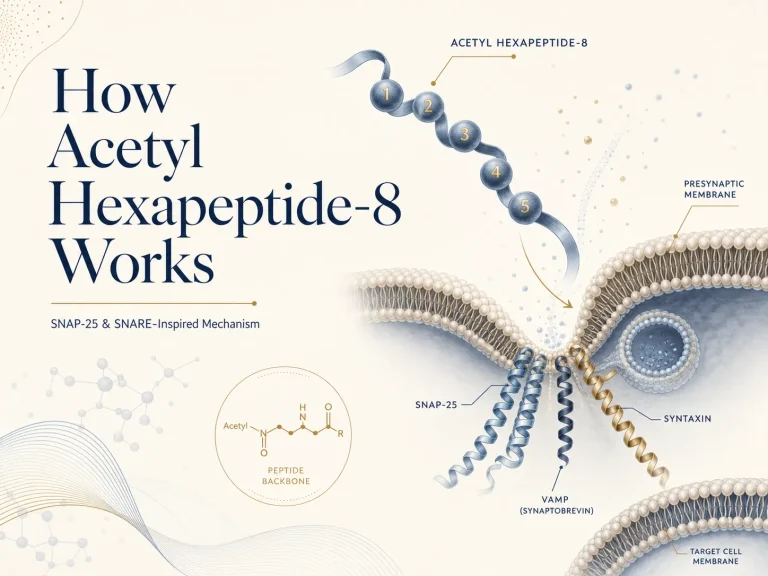
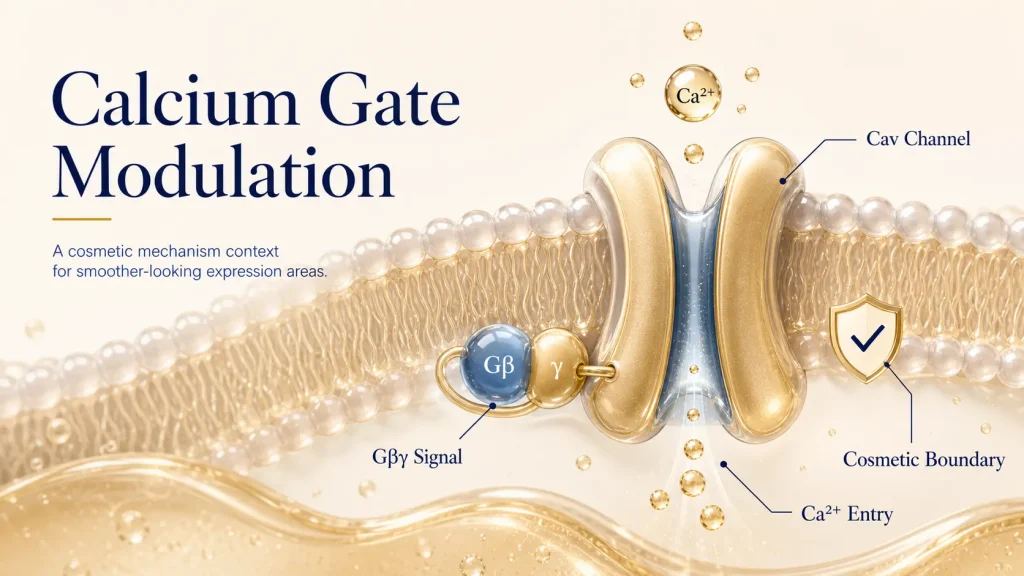
To discuss this cascade responsibly, modern cosmetic chemistry should frame it as receptor-aware signaling context rather than drug-like nerve or channel control. In the upstream model, G-protein coupled receptors (GPCRs), including delta-opioid receptor subtypes described in cutaneous biology, sit near presynaptic membrane environments. When an enkephalin-mimetic peptide is discussed in this context, the mechanism is usually described through ligand recognition, receptor conformational change, and Gi-coupled signaling.
In classical Gi-coupled signaling, receptor activation changes the state of a heterotrimeric G-protein. The Gαi subunit exchanges GDP for GTP, while the Gβγ dimer can participate in downstream signaling near voltage-gated calcium channels. Literature on neuronal ion channels describes how Gβγ interactions can influence calcium-channel behavior. For a cosmetic article, the safer wording is channel modulation or calcium-entry context, not absolute channel shutdown.
This distinction matters commercially. Stable neuropeptides for mature skin care can help brands tell a sophisticated story about smoother-looking expression areas, a more relaxed-looking skin appearance, and a gentler alternative to aggressive anti-aging language. But the finished product still needs appropriate formula testing, compatibility review, sensory assessment, and claim substantiation. The public claim should stay in the cosmetic lane: softer-looking expression lines, improved skin comfort perception, and appearance-based smoothing.
Formulating for Mature Skin Appearance and Longevity Concepts
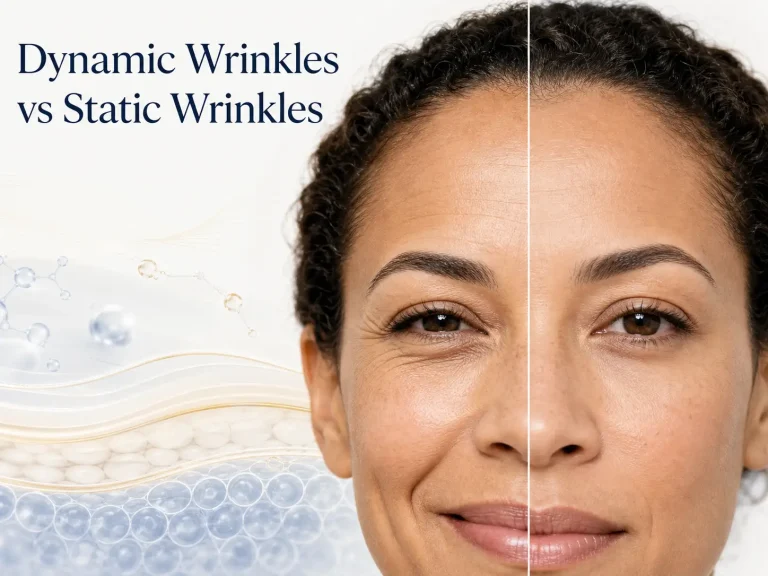
Translating ion-channel science into product development requires a clear understanding of mechanical aging. In mature skin, expression lines are not only surface creases; they are influenced by repeated facial movement, changes in collagen organization, reduced elasticity, dryness, and the way light reflects from the skin surface. When facial muscles contract repeatedly, the overlying skin is folded and stretched. As collagen and elastic fiber quality changes with age, these repeated movements can make expression areas appear more visible over time.
For formulators, this makes stable neuropeptides for mature skin care useful as part of a broader appearance-support system. A formulation may combine neuropeptide positioning with humectants, barrier-support lipids, antioxidants, film-forming sensorial agents, and skin-feel modifiers. Delivery systems such as liquid-crystal emulsions, liposomes, or oleosome-inspired structures can be considered when they are compatible with the peptide, target pH, preservative system, viscosity, packaging, and storage conditions.
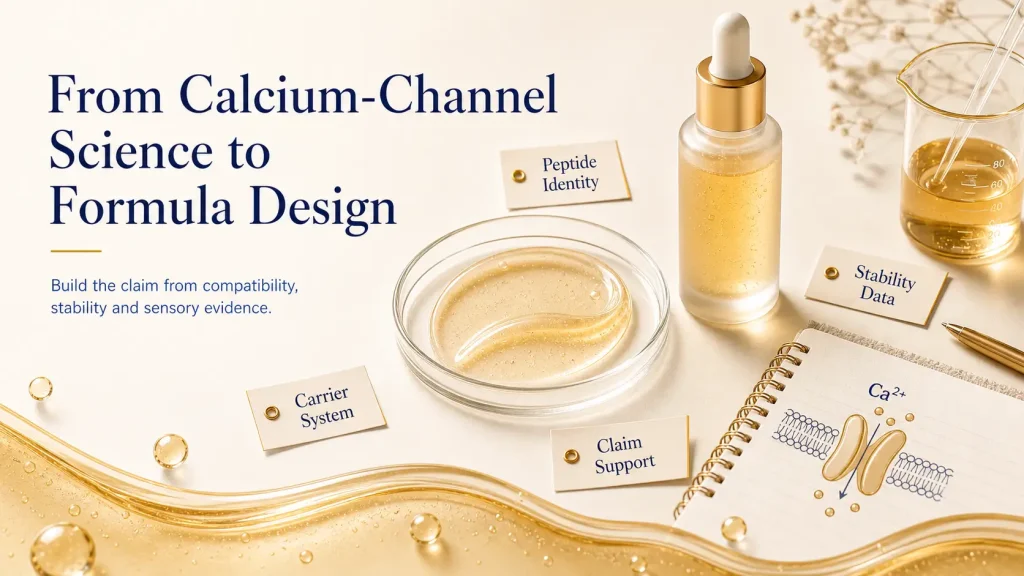
For brands developing serums, eye-care products, creams, or targeted mature-skin formulas, the strongest route is not to overpromise electrophysiology. The stronger route is to connect the mechanism story with practical formulation evidence: peptide identity, suggested use level, stability data, compatibility notes, sensory profile, and claim-support testing. Genopep can support peptide selection and formulation discussion for stable neuropeptide concepts designed for smoother-looking, more comfortable mature skin care. Request a quote with your target format, claim direction, and market requirements.
References
Catterall, W. A. (2011). Voltage-gated calcium channels. Cold Spring Harbor Perspectives in Biology, 3(8), a003947. https://doi.org/10.1101/cshperspect.a003947
Zamponi, G. W., Striessnig, J., Koschak, A., & Dolphin, A. C. (2015). The physiology, pathology, and pharmacology of voltage-gated calcium channels and their future therapeutic potential. Pharmacological Reviews, 67(4), 821-870. https://doi.org/10.1124/pr.114.009654
Tedford, H. W., & Zamponi, G. W. (2006). Direct G protein modulation of Cav2 calcium channels. Pharmacological Reviews, 58(4), 837-862. https://doi.org/10.1124/pr.58.4.11
Naylor, E. C., Watson, R. E. B., & Sherratt, M. J. (2011). Molecular aspects of skin ageing. Maturitas, 69(3), 249-256. https://doi.org/10.1016/j.maturitas.2011.04.011
Reference note: ion-channel literature is used as mechanism background only. It should not be converted into a cosmetic claim of nerve control, medical treatment, or injectable-like muscle paralysis.