Professional Cosmetics Peptide Supplier | GENOPEP



Engineering a Multi-Peptide Serum: Pentapeptide-18 and Argireline Synergy Framework
The Trend of Blending Complementary Actives in Premium Skincare
The premium anti-aging skincare market is moving away from high-concentration, single-ingredient storytelling toward multi-peptide matrices that address visible aging through complementary cosmetic mechanisms. In early clinical-style cosmetics, brands often relied on one high-percentage hero ingredient to attract attention. Formulation chemists now recognize the limitation of that approach: expression lines, loss of smoothness and age-related texture changes are not created by one pathway alone.
For expression-line serums, single-active formulas can reach an early performance ceiling because they emphasize one point in a broader neuromuscular-signaling story. A more sophisticated strategy is to combine compatible peptides at disciplined use levels, allowing each peptide to support a different part of the cosmetic mechanism narrative. This gives brands a stronger technical foundation while keeping the finished product within a cosmetic, appearance-led positioning.
Harnessing the Pentapeptide-18 and Argireline Synergy via Genopep
To unlock true compound efficiency in dynamic line reduction, formulators can leverage the verified Pentapeptide-18 and Argireline synergy using pure raw materials engineered by SkinkindCosmetics. This combination targets the neuromuscular signaling cascade at two separate control points, blocking the release of acetylcholine (ACh) into the synaptic cleft from both the inside and outside of the cell.
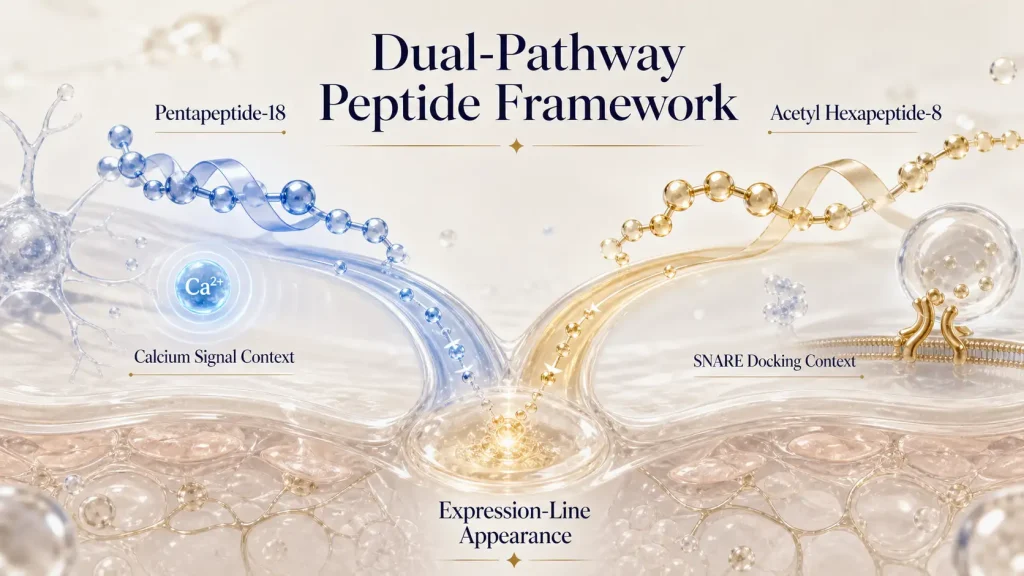
Acetyl Hexapeptide-8 is typically positioned around the downstream SNARE-complex context. In cosmetic mechanism language, it supports a narrative in which vesicle-docking signals are modulated at the appearance level, helping the formula speak to smoother-looking expression lines. The public-facing language should stay cosmetic and appearance-based.
Pentapeptide-18 gives the formula a separate upstream story. It is often described as an enkephalin-mimic peptide associated with the skin’s sensory and relaxation-signaling context. In a finished cosmetic serum, the safest claim architecture is to discuss this as an upstream calcium-signal context for expression-line appearance, not as a direct receptor-activation or calcium-channel-blocking drug claim.
Some supplier dossiers and ingredient-specific datasets report up to 47% wrinkle-depth appearance reduction over 28 days for combined Pentapeptide-18 and Acetyl Hexapeptide-8 concepts. This number should only be used when the same ingredient system, dosage, protocol and finished-formula evidence support it. Without that substantiation chain, the safer public-facing message is dual-pathway expression-line appearance support.
Production Optimization Strategies for Complex Systems
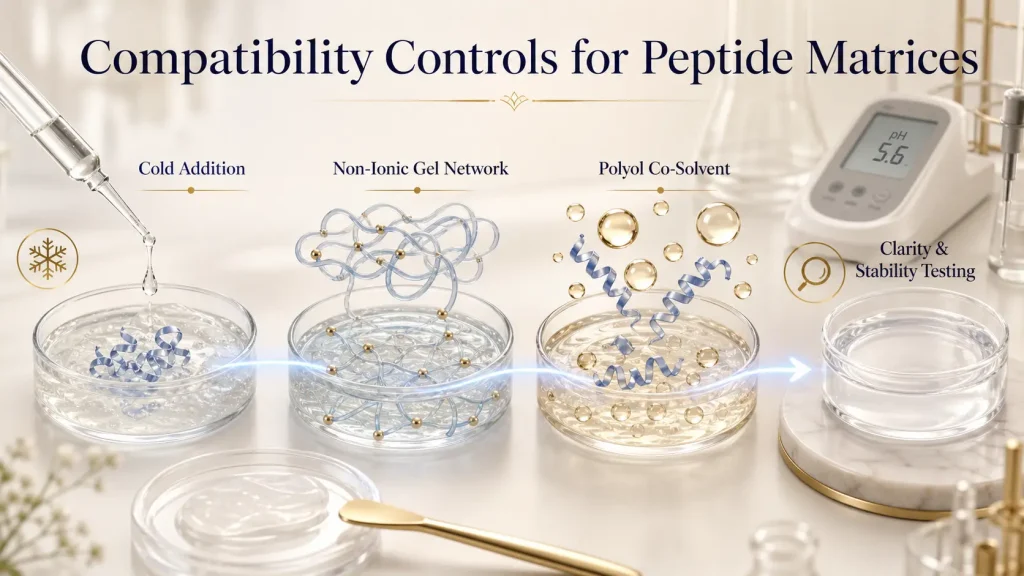
Incorporating multiple delicate peptides into one commercial serum requires tighter process control, especially when moving into 50-to-100-kilogram pilot or commercial batches. Small changes in temperature, mixing shear, pH or polymer compatibility can affect clarity, viscosity and perceived quality. For this reason, the production strategy should be built around cold addition, low-shear distribution and compatibility testing.
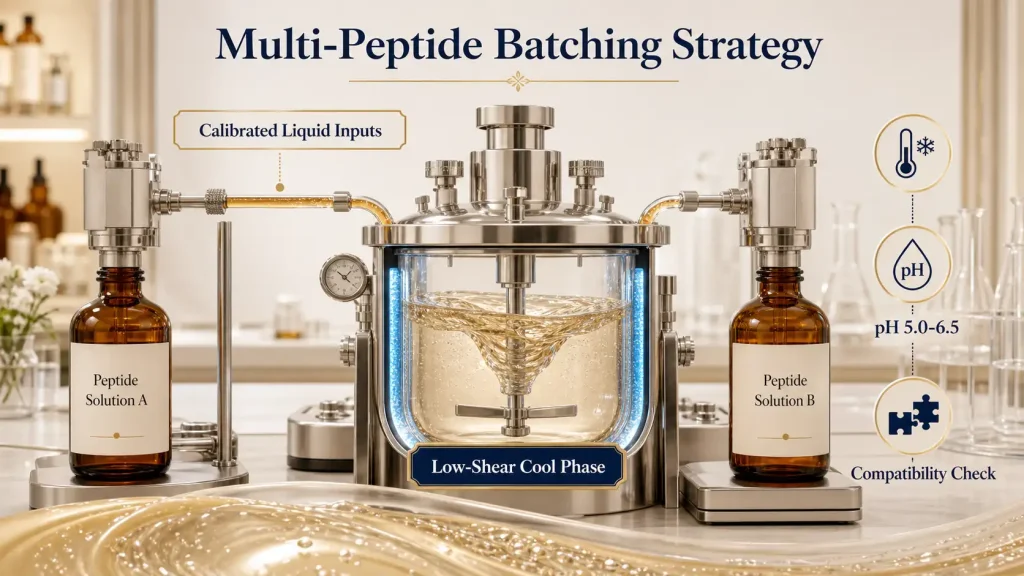
First, use a practical thermodynamic gate. Peptide solutions should be introduced after hot emulsification and homogenization are complete, when the bulk phase has cooled below 40°C. Low-shear anchor mixing can support distribution without unnecessary air incorporation. This approach reduces avoidable heat and mechanical exposure after active addition.
Second, manage ionic compatibility. Peptides can carry different net charges depending on pH and the surrounding formula environment. Highly charged anionic polymers may increase the risk of complex coacervation, precipitation, cloudiness or viscosity loss. Non-ionic or salt-tolerant rheology modifiers such as xanthan gum or hydroxyethylcellulose are often more practical starting points for multi-peptide serum bases.
Finally, use polyol co-solvents such as glycerol or propanediol as part of the stability design. Polyols can help improve wetting, dispersion and water-activity management around peptide-containing systems. They do not remove the need for formal stability, compatibility and preservation testing, but they give formulators a more controlled technical base.
Sourcing and Claim Architecture
For brands and formulators, the sourcing advantage is not simply that a multi-peptide serum contains more actives. The advantage is that the raw materials, processing window and claim language are aligned. Genopep can support teams with high-purity peptide raw material discussion, liquid-format development, batch documentation and formulation review for expression-line serum concepts.
| Formulation Lever | Preferred Positioning | Claim Boundary |
| Pentapeptide-18 | Upstream expression-line appearance context; enkephalin-mimic peptide narrative. | Avoid drug-like receptor activation, paralysis or therapeutic neuromodulation language. |
| Acetyl Hexapeptide-8 | Downstream SNARE-complex-inspired smoothing narrative for dynamic expression lines. | Avoid implying botulinum-like medical action or guaranteed wrinkle removal. |
| Combined matrix | Dual-pathway cosmetic mechanism story for premium expression-line serum concepts. | Use 47% only as a substantiated, dossier-specific appearance claim. |
| Manufacturing system | Low-shear cool phase, pH 5.0-6.5, non-ionic rheology and polyol support. | Do not guarantee universal stability without formula-specific testing. |
References
Blanes-Mira, C., Clemente, J., Jodas, G., Gil, A., Fernandez-Ballester, G., Ponsati, B., Gutierrez, L., Perez-Paya, E., & Ferrer-Montiel, A. (2002). A synthetic hexapeptide with antiwrinkle activity. International Journal of Cosmetic Science, 24(5), 303-310. https://doi.org/10.1046/j.1467-2494.2002.00153.x
Schagen, S. K. (2017). Topical peptide treatments with effective anti-aging results. Cosmetics, 4(2), 16. https://doi.org/10.3390/cosmetics4020016
ISO 11930. Cosmetics – Microbiology – Evaluation of the antimicrobial protection of a cosmetic product.
ICH Q1A(R2). Stability Testing of New Drug Substances and Products. Used here as general stability-study context; finished cosmetic validation should follow applicable cosmetic regulations and internal quality protocols.