Professional Cosmetics Peptide Supplier | GENOPEP



What Does Copper Tripeptide-1 Do for Skin? Evidence, Benefits, and Claim Boundaries
What does Copper Tripeptide-1 do for skin? It is a copper-complexed tripeptide used as a skin-conditioning ingredient and studied in models involving extracellular-matrix turnover, oxidative stress, and inflammatory signaling. These findings create a cosmetic research rationale, while visible benefits still require stable formulation, skin delivery, and finished-product evidence.
Introduction
Copper Tripeptide-1 is often introduced through a long list of benefits: firmer skin, fewer wrinkles, stronger barrier, faster repair, calmer redness, and antioxidant protection. The list sounds efficient, but it combines ingredient classification, laboratory observations, cosmetic endpoints, and medical language as though they were equivalent. They are not.
For brands, formulators, and product teams, the useful question is therefore more precise than “Does it work?” Teams need to ask what can be stated directly about the ingredient, which benefits are biologically plausible, what topical human evidence exists, and what must be demonstrated with the finished formula before a claim is used.
This article addresses topical cosmetic use. Injectable protocols, treatment of wounds or disease, and claims about changing body structure or function fall outside the ordinary cosmetic scope discussed here.
Start With the Ingredient’s Defined Cosmetic Role
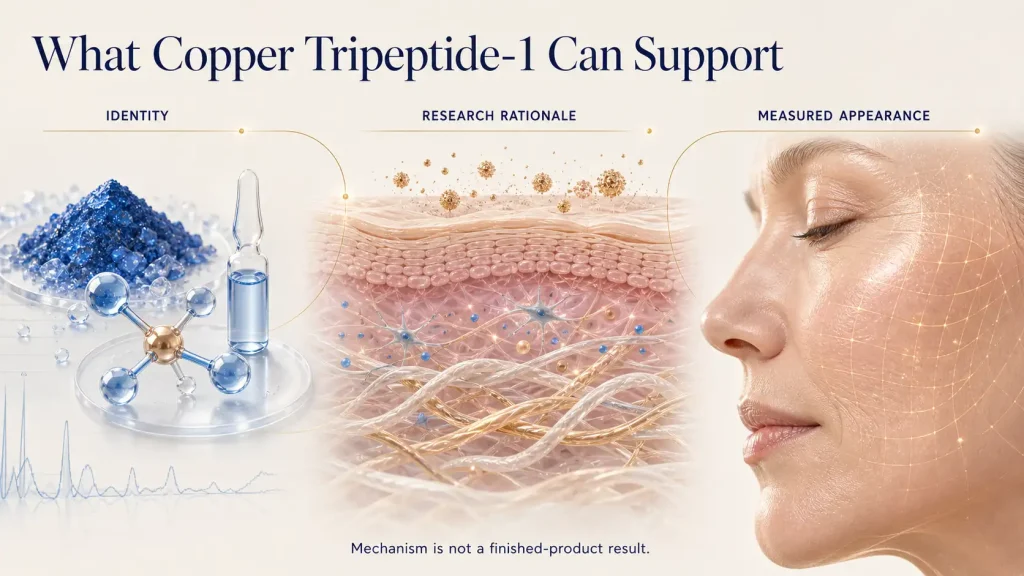
Copper Tripeptide-1 is defined as a complex formed by copper and Tripeptide-1, the Gly-His-Lys sequence commonly abbreviated as GHK. In the Cosmetic Ingredient Review safety assessment, its reported cosmetic function is “skin-conditioning agent—miscellaneous.”[1] This is a useful starting point because it describes how the ingredient is used in cosmetic formulation without promising a specific clinical result.
“Skin conditioning” is deliberately broad. Depending on the complete formula and the evidence generated, it may relate to the appearance or feel of smoother, softer, better-conditioned skin. It does not independently prove that the ingredient repairs a damaged barrier, rebuilds the dermis, increases skin density, or tightens loose skin.
The blue to deep-blue appearance associated with a copper complex can support routine raw-material observation, but shade is not an efficacy test. Identity, peptide content, copper complexation, impurities, counterions, and batch consistency should be assessed through the applicable specification and analytical documents.
What Benefits Have a Mechanistic Rationale?
The most frequently discussed Copper Tripeptide-1 benefits come from experimental research on GHK-Cu. Cell-culture studies have reported changes in fibroblast collagen synthesis and signaling associated with transforming growth factor beta.[2,5] Reviews also discuss extracellular-matrix components, metalloproteinases, antioxidant defenses, and inflammatory mediators.[3,4] Together, these observations support several research directions, but they remain model-dependent.
1. Fine Lines, Texture, and Firm-Looking Skin
Matrix-related studies provide a plausible reason to evaluate fine-line appearance, surface texture, elasticity, or perceived firmness in a topical formula. A mechanistic study showing collagen-related activity in cultured fibroblasts does not mean that a serum automatically increases dermal collagen in users. The ingredient must first remain in the intended chemical form, be available from the vehicle, reach a relevant site, and produce a measurable finished-product result.
Cosmetic wording should match the measured endpoint. “Improves the appearance of fine lines” is an appearance claim that can be investigated with validated imaging, expert grading, or instrumental methods. “Regenerates collagen,” “rebuilds the dermis,” or “reverses sagging” makes a broader structural promise and cannot be supported by an ingredient mechanism alone.
2. Better-Conditioned or More Comfortable-Looking Skin
The skin-conditioning classification supports development of formulas intended to leave skin looking or feeling better conditioned. Laboratory literature concerning oxidative-stress and inflammatory pathways may also justify research into visible redness, discomfort-related appearance, or recovery from ordinary environmental stress.[3,4] These endpoints need precise language and suitable testing.
“Supports a comfortable, healthy-looking complexion” remains within an appearance-oriented cosmetic frame when substantiated. “Treats inflammation,” “heals injured skin,” “prevents UV damage,” or “repairs DNA” moves into therapeutic, preventive, or structural territory. A molecule’s participation in repair biology does not make every cream containing it a repair treatment.
3. Barrier-Related Positioning
Barrier language requires particular care. A finished formula can improve hydration, reduce transepidermal water loss, support a smoother surface, or improve the appearance of a compromised-looking complexion through many components of the vehicle. Copper Tripeptide-1 may be part of that design, but the result cannot automatically be assigned to the peptide.
If a brand wants to claim “supports the skin barrier,” it should define the intended meaning and choose matching endpoints. Hydration, transepidermal water loss, visible flaking, expert-assessed dryness, and user-reported comfort are related but not interchangeable. “Repairs the barrier” is also stronger than “helps support the appearance and comfort of well-conditioned skin.”
The Evidence Ladder: From Plausible to Product-Specific
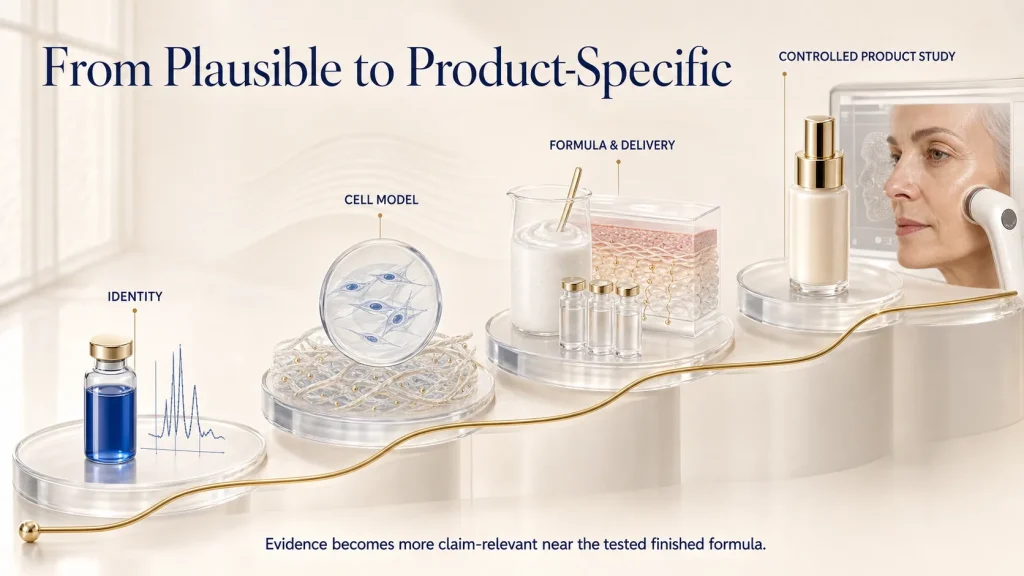
Evidence becomes more directly relevant to a market claim as it moves closer to the actual product and user. Chemical identity can confirm what the ingredient is. Cell studies can identify a plausible biological response. Penetration or distribution studies can show what happened in a specific model. Controlled human studies can evaluate the tested formula, population, use pattern, and endpoint.
| Evidence Level | What It Answers | Main Limitation |
| Identity and analytical data | Is the supplied material the intended Copper Tripeptide-1, and at what content or purity basis? | Does not demonstrate a skin benefit |
| Biochemical or cell model | Is a proposed pathway or response plausible under the test conditions? | Does not reproduce the complete topical-use environment |
| Formulation, stability, and delivery study | Does the ingredient remain available and behave as intended in the selected vehicle or model? | Does not independently establish a visible consumer result |
| Controlled finished-product study | Does the tested product improve the defined cosmetic endpoint in the tested users? | Applies to the tested formula, population, method, and duration |
What Does the Topical Human Evidence Show?
The topical human evidence is smaller and less consistent than broad benefit lists imply. In a randomized study after carbon-dioxide laser resurfacing, 13 participants completed regimens with or without GHK-Cu products. Blinded and computer-based assessments found no significant between-group difference in erythema resolution, wrinkles, or overall skin quality, although user satisfaction was higher in the GHK-Cu group.[7]
The result should neither be ignored nor treated as the final verdict on every Copper Tripeptide-1 formula. The sample was small, the skin had undergone a procedure, and the tested regimen is not equivalent to every current serum. It does show why mechanistic promise and consumer outcome should remain separate until the exact formula is tested.
A 2024 systematic review found limited clinical literature for topical peptide approaches and called for trials with defined objective endpoints.[8] A 2026 meta-analysis included 19 randomized peptide trials for skin aging, but 17 investigated oral peptides and only two assessed topical interventions.[9] Pooled peptide results therefore cannot be presented as direct proof for GHK-Cu or for an untested finished product.
The evidence-based conclusion is balanced: Copper Tripeptide-1 has credible identity, safety, and mechanistic literature, while the magnitude, timing, and reproducibility of visible topical benefits depend on the specific formulation and its substantiation.
Safety Does Not Equal Universal Tolerability
The CIR Expert Panel concluded that Copper Tripeptide-1 and the other assessed ingredients were safe in the present practices of use and concentration described in its assessment.[1] The report discussed customary low peptide use levels and negative safety data available for the group. This supports cosmetic use within the evaluated context; it is not a universal approval of every concentration, route, formula, or claim.
Finished-product tolerance is still formulation-specific. pH, solvent system, preservatives, fragrance, other actives, impurities, application site, frequency, and user condition can change irritation or sensitization risk. Product teams should complete the relevant safety assessment and stability program for the intended market and use pattern.
A Practical Claim-Boundary Matrix
European cosmetic claim criteria state that an ingredient-property claim must not imply that the finished product has the same property when it does not, and extrapolation from ingredient properties to a finished product requires adequate and verifiable evidence.[11] In the United States, FDA explains that claims to treat disease or affect body structure or function can cause a product to be regulated as a drug.[10]
| Proposed Message | More Defensible Cosmetic Direction | Evidence Needed |
| Copper Tripeptide-1 repairs DNA | Avoid as an ordinary cosmetic claim | Market-specific regulatory review; ingredient literature alone is insufficient |
| The formula rebuilds collagen and elastin | Improves the appearance of firmness, elasticity, or fine lines | Controlled finished-product measurements matching each endpoint |
| The product heals damaged skin | Helps skin look calmer, smoother, or better conditioned | Defined visible, instrumental, expert, or consumer endpoint for the formula |
| Copper peptides reverse sagging | Helps improve the appearance of firm, resilient-looking skin | Validated firmness or elasticity study; no implication of structural lifting |
| Clinically proven Copper Tripeptide-1 benefits | The tested formula produced the stated result under the reported study conditions | Complete study design, statistics, formula identity, population, duration, and claim wording |

What Product Teams Should Verify Before Using a Benefit Claim
First, verify identity and content basis. “95% HPLC purity,” peptide content in ppm, copper content, and the concentration of a supplied solution answer different questions. They should not be substituted for one another or converted into a finished-product use level without the applicable TDS, COA, and calculation basis.
Second, verify formula compatibility and stability. Peptides and copper complexes may be affected by pH, oxidation, light, heat, enzymes, chelators, and other ingredients capable of binding or changing the oxidation state of copper. Color change can be an investigation signal, but color retention alone does not prove intact identity or biological availability.
Third, select a finished-product endpoint before writing the claim. If the commercial objective is firm-looking skin, define the instrument, grading scale, consumer question, study duration, and statistical plan. If the objective is barrier support, select hydration, transepidermal water loss, dryness, flaking, or comfort endpoints deliberately. The claim should be the final expression of the test plan, not the starting assumption.
Skinkind Cosmetics currently lists Copper Tripeptide-1 as a blue to deep-blue powder with HPLC purity options of at least 95% or 98%, and as a customizable blue solution with 1,000 to 50,000 ppm peptide content.[12] These are supplier-format specifications rather than universal efficacy thresholds. The relevant batch documents and formula-specific validation remain necessary.
Conclusion
Copper Tripeptide-1 is best understood as a skin-conditioning cosmetic ingredient with a credible mechanistic research base, not as a shortcut from laboratory biology to a guaranteed consumer result. Its most defensible development directions include the appearance of fine lines, texture, firmness, elasticity, and well-conditioned skin, provided that the finished formula is stable, tolerable, and tested against the exact endpoint used in the claim.
For product teams, the practical sequence is identity first, formula behavior second, finished-product measurement third, and claim wording last. This sequence preserves the scientific value of GHK-Cu research while keeping product communication proportional to the available evidence.
Frequently Asked Questions
1. What does Copper Tripeptide-1 do for the skin?
Copper Tripeptide-1 is used as a skin-conditioning cosmetic ingredient and has mechanistic research involving extracellular-matrix turnover, oxidative stress, and inflammatory signaling. These findings support research into fine-line, texture, firmness, and conditioned-skin appearance. A specific finished product must still demonstrate its own result.
2. Do copper peptides help sagging skin?
Copper-peptide research provides a rationale for evaluating firmness or elasticity appearance, but a topical cosmetic cannot be assumed to lift structurally sagging tissue. A defensible product claim should describe the measured appearance endpoint and be supported by testing of the actual finished formula.
3. How long do copper peptides take to work?
There is no universal timeline for all copper-peptide products. Hydration or sensory effects may appear sooner because of the complete vehicle, while wrinkle, firmness, or elasticity endpoints normally require repeated use and a defined evaluation period. Use the timeline demonstrated for the exact formula.
4. What are the downsides of copper peptides?
Potential limitations include formula instability, interactions with other ingredients, uncertain delivery, irritation from the complete product, and overstatement of limited human evidence. These are development and substantiation questions rather than proof that Copper Tripeptide-1 is inherently unsuitable for cosmetics.
5. Is GHK-Cu safe for topical use?
The CIR Expert Panel concluded that Copper Tripeptide-1 was safe in the present practices of use and concentration described in its assessment.[1] Brands must still assess the intended finished formula, exposure, impurities, application site, and local market requirements. Ingredient safety and universal product tolerance are not the same conclusion.
CTA
For product teams asking what does Copper Tripeptide-1 do for skin, the practical next step is to convert the proposed benefit into a formula and substantiation plan. Genopep supports ingredient and formulation development, while Skinkind Cosmetics can provide current Copper Tripeptide-1 powder or customizable solution information and relevant technical documents. Request the applicable TDS, batch COA, and sample data, then confirm identity, content basis, compatibility, stability, safety, and the finished-product endpoint before finalizing claims.
Review Skinkind Cosmetics Copper Tripeptide-1 Formats and Request Technical Documents
References
1. Johnson W Jr, Bergfeld WF, Belsito DV, et al. Safety Assessment of Tripeptide-1, Hexapeptide-12, Their Metal Salts and Fatty Acyl Derivatives, and Palmitoyl Tetrapeptide-7 as Used in Cosmetics. International Journal of Toxicology. 2018;37(Suppl 3):90S-102S. CIR safety assessment
2. Maquart FX, Pickart L, Laurent M, Gillery P, Monboisse JC, Borel JP. Stimulation of Collagen Synthesis in Fibroblast Cultures by the Tripeptide-Copper Complex Glycyl-L-Histidyl-L-Lysine-Cu2+. FEBS Letters. 1988;238(2):343-346. PubMed record
3. Pickart L, Vasquez-Soltero JM, Margolina A. Regenerative and Protective Actions of the GHK-Cu Peptide in the Light of the New Gene Data. International Journal of Molecular Sciences. 2018;19(7):1987. PMC full text
4. Pickart L, Margolina A. GHK Peptide as a Natural Modulator of Multiple Cellular Pathways in Skin Regeneration. BioMed Research International. 2015;2015:648108. PMC full text
5. Gruchlik A, Chodurek E, Dzierzewicz Z. Effect of GLY-HIS-LYS and Its Copper Complex on TGF-β Secretion in Normal Human Dermal Fibroblasts. Acta Poloniae Pharmaceutica. 2014;71(6):954-958. PubMed record
6. Mazurowska L, Mojski M. Human Skin Penetration of a Copper Tripeptide In Vitro as a Function of Skin Layer. Skin Pharmacology and Physiology. 2010;23(5):266-271. PubMed record
7. Miller TA, Wagner JD, Baack BR, Eisbach KJ. Effects of Topical Copper Tripeptide Complex on CO2 Laser-Resurfaced Skin. Archives of Facial Plastic Surgery. 2006;8(4):252-259. PubMed record
8. Ash M, Zibitt M, Shauly O, Menon A, Losken A, Gould D. The Innovative and Evolving Landscape of Topical Exosome and Peptide Therapies: A Systematic Review of the Available Literature. Aesthetic Surgery Journal Open Forum. 2024;6:ojae017. PMC full text
9. Nukaly HY, Halawani IR, Irtaza HM, et al. Oral and Topical Peptides for Skin Aging: Systematic Review and Meta-Analysis of Randomized Controlled Trials. Frontiers in Medicine. 2026;13:1618306. PMC full text
10. U.S. Food and Drug Administration. Cosmetics Labeling Claims. FDA guidance
11. European Commission. Commission Regulation (EU) No 655/2013 Laying Down Common Criteria for the Justification of Claims Used in Relation to Cosmetic Products. EU regulation
12. Skinkind Cosmetics / GENOPEP. Copper Tripeptide-1 (CAS: 49557-75-7) Anti-Aging Peptides. Product page