Professional Cosmetics Peptide Supplier | GENOPEP



What Should You Not Mix with Copper Peptides? Formula Compatibility Evidence vs Skincare Myths
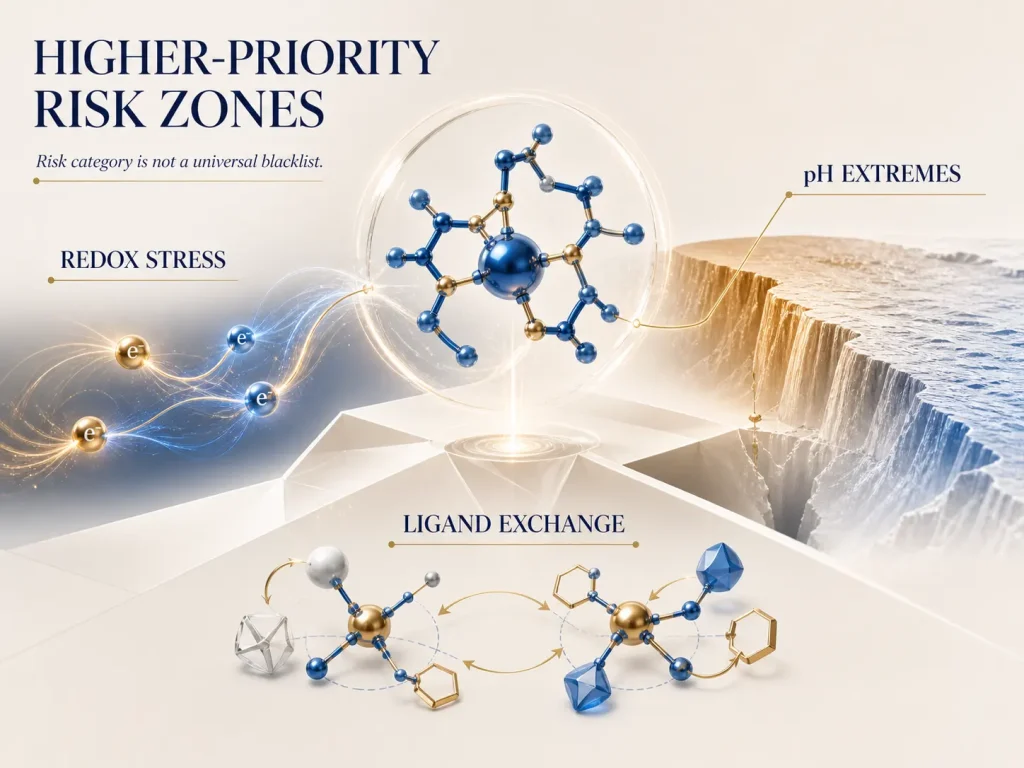
What not to mix with copper peptides cannot be answered by a universal blacklist. For Copper Tripeptide-1/GHK-Cu, the most defensible formula-level cautions concern strong oxidative or reductive conditions, extreme pH, and ingredients or excipients that can alter copper coordination. Pure L-ascorbic acid deserves particular scrutiny because it combines a low-pH requirement with copper-related redox chemistry. Strong acid systems, competing ligands, chelators, and some ionic excipients also require compatibility testing. Retinol, niacinamide, hyaluronic acid, and other named skincare actives are not automatically incompatible merely because an online layering chart says so. The finished formula, concentrations, pH, vehicle, process, packaging, and analytical results determine compatibility.
Introduction
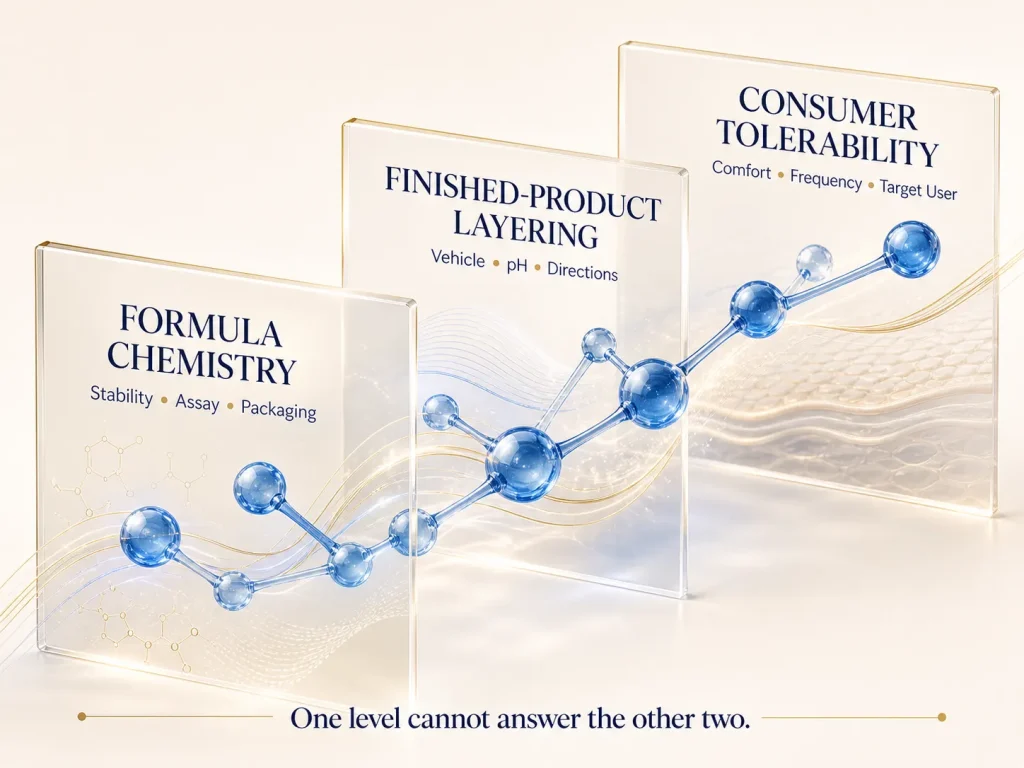
Searches for what should you not mix with copper peptides often produce confident rules: never use copper peptides with vitamin C, retinol, exfoliating acids, or anything “active.” Those rules merge three different questions. The first is whether two raw materials remain chemically compatible in one formula. The second is whether two separate finished products remain stable when layered. The third is whether the combined routine is comfortable for a particular user. A result from one level cannot automatically answer the other two.
In this article, “copper peptides” refers mainly to Copper Tripeptide-1, commonly discussed as GHK-Cu. It is a copper complex of the Gly-His-Lys tripeptide, not free copper added to a formula and not every blue or copper-containing ingredient.[1,2] That identity matters because coordination state, redox conditions, pH, competing ligands, and analytical definition can all affect the material differently from an ordinary non-metal peptide.
The useful development question is therefore not “Which ingredient name is forbidden?” It is “Which chemical or use condition could change the copper-peptide complex, destabilize another active, or create an unacceptable consumer experience—and how will the finished system be tested?”
Three Compatibility Questions That Should Not Be Confused
| Compatibility Level | Question | Evidence Needed |
| Raw-material/formula compatibility | Can Copper Tripeptide-1 and another material coexist through manufacture and shelf life? | pH and process records, appearance, identity/content or stability-indicating assay, degradation profile, packaging study |
| Finished-product layering | What happens when two independently formulated products meet on skin? | Product-specific directions, pH and vehicle context, controlled use testing where relevant |
| Consumer tolerability | Does the routine increase dryness, stinging, redness, or misuse risk? | Safety assessment, patch/use testing, frequency and target-user instructions |
What the Published Formulation Evidence Actually Shows
A preformulation study evaluated GHK-Cu under stressed conditions and with selected delivery-system components. Under the reported conditions, GHK-Cu was susceptible to basic and oxidative stress, and less affected by acidic stress. It remained stable in water and in buffers from pH 4.5 to 7.4 for at least two weeks at 60 °C. It was compatible with Span 60-based niosomes but less stable in the presence of the negatively charged lipid dicetyl phosphate.[3] These findings are useful, but they do not validate every commercial emulsion, serum, acid, antioxidant, preservative, chelator, or packaging system.
Later liposome research also shows why formulation architecture matters. GHK-Cu loading, lipid composition, particle characteristics, encapsulation efficiency, release, and stability changed with the carrier system.[4,5] Compatibility is therefore not a property of two ingredient names alone. It is an experimentally observed property of a defined material in a defined system.
High-Priority Formula Risks
1. Pure L-Ascorbic Acid: a Real Question, Not a Universal Consumer Ban
Pure L-ascorbic acid is usually developed as an oxidation-sensitive active, and classic skin-delivery work used a pH below 3.5.[6] Separate solution-chemistry research confirms that ascorbate and copper ions can participate in Cu(II)/Cu(I) redox cycling and ascorbic-acid oxidation.[7,8] GHK-Cu itself can be reduced under sufficiently reducing conditions with release or redistribution of copper species.[8] This makes high-strength L-ascorbic-acid systems a legitimate co-formulation risk to investigate.
However, this does not prove that every vitamin C derivative, every finished vitamin C product, or every separated morning/evening routine “cancels” Copper Tripeptide-1. Derivatives have different structures, phases, pH needs, and redox behavior. A combined concept requires ingredient-specific testing; two separate products require product-specific directions and tolerability judgment.
2. Strong Oxidizing or Reducing Environments
The preformulation study identified oxidative stress as a meaningful degradation route for GHK-Cu.[3] Reductants can also change copper oxidation state or coordination behavior.[7-9] Formulators should therefore examine the complete redox environment: antioxidants and oxidants, trace metals, peroxide impurities, dissolved oxygen, light exposure, headspace, processing temperature, and packaging—not merely whether the label contains the word “antioxidant.”
3. Extreme pH and Strong Acid Systems
The available preformulation data do not support the simplistic claim that “all acids instantly destroy GHK-Cu.” GHK-Cu remained stable in the tested pH 4.5–7.4 buffers, while basic stress caused greater cleavage than acidic stress.[3] Nevertheless, a finished formula outside the supplier-recommended or validated pH window can alter peptide stability, copper coordination, preservative performance, viscosity, color, and skin comfort. Strong AHA/BHA systems should therefore be treated as validation questions, especially when the same product also carries a low-pH target.
4. Chelators, Competing Ligands, and Ionic Excipients
GHK-Cu is a coordination complex. Molecules able to bind copper, alter the ionic environment, or form ternary complexes can potentially change its speciation. Structural studies show that Cu(II)-GHK can participate in ligand exchange and ternary-complex behavior.[8,10] The observation that one negatively charged lipid reduced stability while another carrier worked under the studied conditions reinforces the need for excipient-specific screening.[3]
This does not justify saying that every formula containing EDTA, citrate, amino acids, phosphates, botanical ligands, or polymers is automatically invalid. Concentration, binding strength, sequence of addition, pH, copper-to-peptide balance, and the complete matrix matter. The correct response is to screen the candidate system and define what analytical result will count as retained Copper Tripeptide-1.
Ingredients That Are Often Overclassified as “Forbidden”
Retinol
No general rule proves that every Copper Tripeptide-1 product is chemically incompatible with every retinol product. Retinol has its own major stability liabilities—light, oxygen, heat, metal ions, vehicle, antioxidants, and packaging—and commercial products vary substantially.[11,12] A same-formula project must test both actives and their protection systems. Separate finished products may be used in different routines or occasions when their directions and consumer tolerance support that approach. This article does not replace the dedicated Copper Peptides with Retinol compatibility assessment planned for C4.
Niacinamide, Hyaluronic Acid, and Gentle Humectants
Ingredient-name blacklists often place ordinary hydrators beside strong acids and reductants without evidence. There is no basis in the cited GHK-Cu preformulation work for declaring niacinamide, hyaluronic acid, glycerin, panthenol, or every peptide automatically incompatible. They still require normal formula development: pH fit, preservation, viscosity, color, packaging, safety, and stability. “No identified universal conflict” is not the same as “compatibility proven for every formula.”
A Formula-Compatibility Evidence Matrix
| Candidate Combination | Main Scientific Question | Evidence-Based Development Position |
| Pure L-ascorbic acid + Copper Tripeptide-1 | Low pH and copper/ascorbate redox chemistry | High-priority compatibility risk; do not assume co-formulation without analytical stability data |
| Strong AHA/BHA or extreme-pH system | Peptide stability, copper coordination, preservation and irritation | Validate exact pH, concentrations, process and finished formula; “all acids forbidden” is too broad |
| Oxidants/reductants and peroxide-prone materials | Oxidative cleavage or altered copper state | Control impurities, oxygen, light and process; use stability-indicating tests |
| Chelators/competing ligands/ionic excipients | Ligand exchange, copper redistribution or complex change | Screen each excipient and concentration; color alone is insufficient evidence |
| Retinol | Both actives have formula-dependent stability systems | Not an automatic ban; same-formula and routine questions require separate validation |
| Niacinamide/hyaluronic acid/humectants | General matrix, pH and preservation fit | No universal incompatibility established; complete normal finished-formula testing |
How R&D Teams Should Test a Suspected Conflict
- Define the material: confirm INCI identity, powder or solution format, peptide-content basis, copper-related specification, impurities, solvent and supplier storage instructions.
- Define the risk hypothesis: pH shift, oxidation, reduction, ligand exchange, precipitation, color change, assay loss, viscosity drift, preservative failure, packaging interaction, or increased irritation.
- Build controls: test the complete combination against appropriate single-active and vehicle controls under real processing conditions.
- Select analytical endpoints: appearance and blue color may be observed, but use identity/content or stability-indicating methods, pH, relevant degradation markers, physical stability and microbiological controls as applicable.
- Test the package and use cycle: include light, oxygen, headspace, temperature, dispensing and in-use exposure appropriate to the intended product.
- Translate results into instructions and claims: avoid universal compatibility promises and define any separation, frequency, warning or packaging requirement from the tested system.

Conclusion
What not to mix with copper peptides is a formulation question, not a fixed ingredient blacklist. For Copper Tripeptide-1/GHK-Cu, the strongest reasons for additional scrutiny are redox-active systems, extreme pH, and materials that may alter copper coordination or the ionic environment. Pure L-ascorbic acid is a high-priority example because its low-pH formulation needs intersect with copper-related redox chemistry. Retinol, niacinamide, hyaluronic acid, and other named actives should not be declared universally incompatible without evidence from the actual formula or finished-product routine. Define the failure mode, build controls, measure the complete system, and base directions and claims on finished-product validation.
CTA
If your team is evaluating what not to mix with copper peptides, replace the generic blacklist with a written compatibility hypothesis and test plan. Genopep and Skinkind Cosmetics can provide current Copper Tripeptide-1 powder or customizable solution information and relevant technical documents. Request the applicable TDS, batch COA, SDS, sample, content basis and storage information, then test the exact material in your target pH, vehicle, process, packaging and active system before approving claims or consumer directions.
Review Skinkind Cosmetics Copper Tripeptide-1 Formats and Request Technical Documents
Frequently Asked Questions
1. What ingredients should you not mix with copper peptides?
For co-formulation, prioritize investigation of pure L-ascorbic acid systems, strong oxidative or reductive conditions, extreme pH, and materials that may compete for copper or change the ionic environment. This is a risk-based testing list, not proof that every named ingredient in those categories always fails.
2. What cancels out copper peptides?
“Cancels out” is not a precise analytical term. A formula may alter copper coordination, reduce or oxidize a component, lower peptide content, generate degradation products, or simply create an unstable physical system. Teams should define the failure mode and measure it rather than infer loss of activity from an ingredient list or color alone.
3. Can you mix retinol and GHK-Cu together?
There is no universal answer for all finished products. A combined formula must demonstrate retention and stability of both actives and acceptable safety. For separate products, follow product-specific instructions and consider alternating use if the routine becomes irritating or overly complex. Do not treat separation as proof of chemical compatibility.
4. Can GHK-Cu be mixed with niacinamide?
The cited evidence does not establish a universal GHK-Cu/niacinamide incompatibility. A product developer should still test the actual concentrations, pH, solvent system, preservatives, color, stability and package. Consumers should follow the directions for the finished products rather than mix raw materials themselves.
5. What can I pair copper peptides with?
Gentle cleansers, moisturizers, humectants and sunscreen can often fit a copper-peptide routine, but the exact answer depends on the finished products. For formula development, no pairing should be approved solely from category names; review supplier data and test the specific system. Sunscreen remains a separate photoprotection step and Copper Tripeptide-1 does not provide SPF.
References
1. Johnson W Jr, Bergfeld WF, Belsito DV, et al. Safety Assessment of Tripeptide-1, Hexapeptide-12, Their Metal Salts and Fatty Acyl Derivatives, and Palmitoyl Tetrapeptide-7 as Used in Cosmetics. International Journal of Toxicology. 2018;37(Suppl 3):90S-102S. CIR final safety assessment
2. Hureau C, Eury H, Guillot R, et al. X-ray and Solution Structures of Cu(II) GHK and Cu(II) DAHK Complexes: Influence on Their Redox Properties. Chemistry – A European Journal. 2011;17(36):10151-10160. PubMed record
3. Badenhorst T, Svirskis D, Wu Z. Physicochemical Characterization of Native Glycyl-L-Histidyl-L-Lysine Tripeptide for Wound Healing and Anti-Aging: A Preformulation Study for Dermal Delivery. Pharmaceutical Development and Technology. 2016;21(2):152-160. PubMed record
4. Dymek M, Olechowska K, Hąc-Wydro K, Sikora E. Liposomes as Carriers of GHK-Cu Tripeptide for Cosmetic Application. Pharmaceutics. 2023;15(10):2485. PMC full text
5. Miksa B, et al. Are We Ready to Measure Skin Permeation of Modern Antiaging GHK-Cu Tripeptide Encapsulated in Liposomes? Molecules. 2025;30(1):136. PMC full text
6. Pinnell SR, Yang H, Omar M, et al. Topical L-Ascorbic Acid: Percutaneous Absorption Studies. Dermatologic Surgery. 2001;27(2):137-142. PubMed record
7. Saeeduddin, et al. Kinetic Modeling Assisted Analysis of Vitamin C-Mediated Copper Redox Transformations in Aqueous Solutions. Journal of Physical Chemistry A. 2023. PubMed record
8. Kotuniak R, et al. Intermediate Cu(II)-Thiolate Species in the Reduction of Cu(II)GHK by Glutathione: A Handy Chelate for Biological Cu(II) Reduction. Inorganic Chemistry. 2021. PubMed record
9. Ahmad S, et al. Topically Applied GHK as an Anti-Wrinkle Peptide: Advantages, Problems and Prospective. BioImpacts. 2025;15:30071. PMC full text
10. Bossak-Ahmad K, Wiśniewska MD, Bal W, Drew SC, Frączyk T. Ternary Cu(II) Complex with GHK Peptide and Cis-Urocanic Acid as a Potential Physiologically Functional Copper Chelate. International Journal of Molecular Sciences. 2020;21(17):6190. PMC full text
11. Temova Rakuša Ž, Škufca P, Kristl A, Roškar R. Retinoid Stability and Degradation Kinetics in Commercial Cosmetic Products. Journal of Cosmetic Dermatology. 2021;20(7):2350-2358. PubMed record
12. Le Digabel J, et al. An Eco-Friendly System for Stabilization of Retinol: A Step Towards Attending Performance with Improved Environmental Respect. International Journal of Cosmetic Science. 2023. PubMed record
13. Skinkind Cosmetics / GENOPEP. Copper Tripeptide-1 (CAS: 49557-75-7) Anti-Aging Peptides. Product page