Professional Cosmetics Peptide Supplier | GENOPEP



What pH Is Best for Copper Tripeptide-1? Stability and Formula-Validation Considerations
There is no universal best pH for Copper Tripeptide-1 in every cosmetic formula. The current Skinkind Cosmetics product page identifies pH 5.0-7.0 as the preferred range, while a published GHK-Cu preformulation study reported stability in specific pH 4.5-7.4 buffer systems for at least two weeks at 60°C. Product teams should use the supplier range as a starting window, then validate the actual raw material, vehicle, process and package.
Introduction
“What pH is best?” sounds like a request for one number. In formulation work, however, the useful answer is a controlled development range plus an acceptance protocol. Copper Tripeptide-1 is a copper-peptide complex, so the final decision must consider peptide integrity, copper-complex behavior, oxidation, excipient interactions, preservation, processing and packaging rather than pH alone.
This article discusses topical cosmetic development only. It does not provide instructions for injection, reconstitution for medical use or treatment of disease. It also does not treat a short stress study as proof of finished-product shelf life.
What Does “Best pH” Mean in Product Development?
For an R&D team, “best” should mean that the formula remains within predefined specifications throughout its intended life. That includes more than a pH reading at the time of manufacture. A defensible target should support chemical integrity, physical appearance, acceptable viscosity and odor, preservation, packaging compatibility and the intended cosmetic claim file.
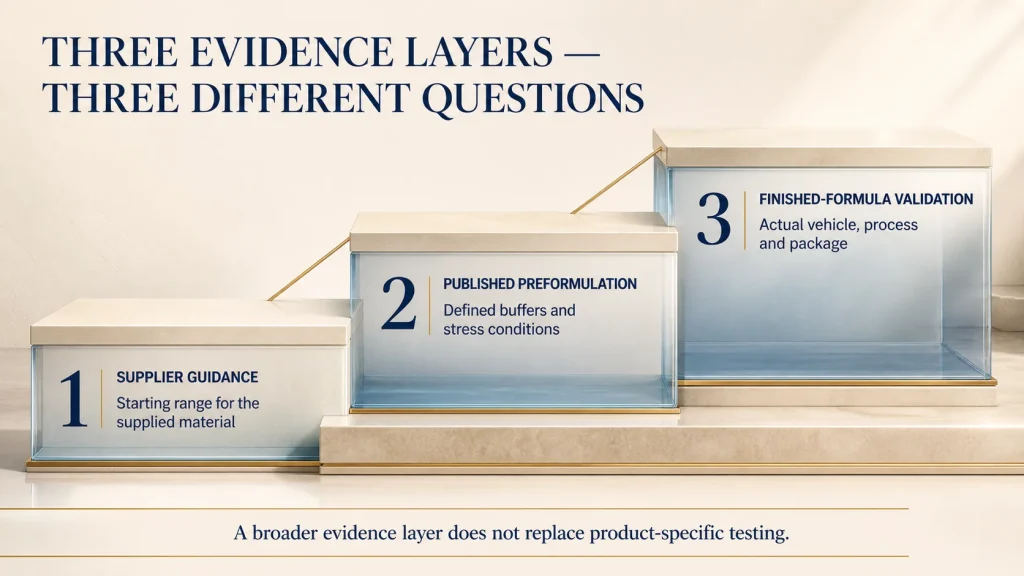
| Evidence Layer | What It Can Support | What It Cannot Prove |
| Current supplier guidance | A practical starting range for the supplied Copper Tripeptide-1 material | Universal stability in every serum, cream, buffer or package |
| Published preformulation study | Behavior of the tested GHK-Cu material under defined buffers and stress conditions | Commercial shelf life or compatibility with an untested finished formula |
| Finished-formula validation | Stability of the actual prototype, process and package against agreed specifications | Performance of other raw-material grades or future formula changes |
What the Published GHK-Cu Stability Study Actually Found
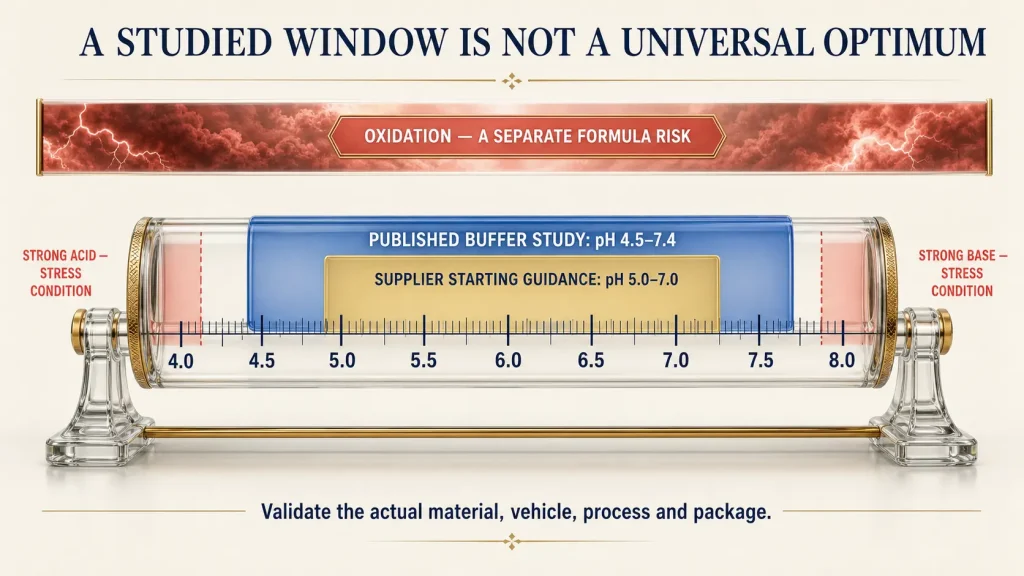
A preformulation study by Badenhorst and colleagues evaluated GHK-Cu solubility, distribution behavior, stress stability and compatibility with selected formulation components. The authors reported that the tested material was stable in water and in pH 4.5-7.4 buffers for at least two weeks at 60°C. The same study also found susceptibility to strong alkaline and oxidative stress, with acidic stress having a smaller effect under the tested forced-degradation conditions.[1]
These results are useful, but their scope matters. A defined buffer solution is simpler than a commercial emulsion or serum containing preservatives, polymers, botanical extracts, antioxidants, chelators, fragrance, salts and packaging-contact materials. Two weeks of elevated-temperature testing also does not establish a market-ready expiry date. ISO/TR 18811:2018 explicitly notes that cosmetic diversity prevents a single universal stability method and places responsibility on the manufacturer to justify its own protocol.[5]
A Practical Starting Range for Prototype Screening
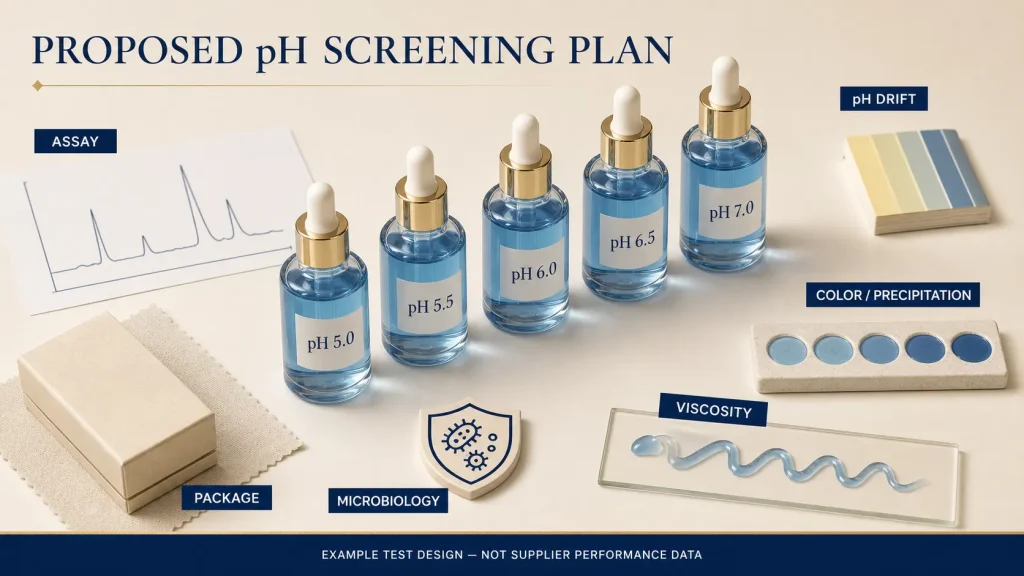
For the supplied ingredient described on the current Copper Tripeptide-1 product page, pH 5.0-7.0 is the documented starting guidance.[8] That range should be carried into the R&D brief as a supplier-specific input, not rewritten as a universal scientific law. A practical first screen can compare matched prototypes at pH 5.0, 5.5, 6.0, 6.5 and 7.0 while holding formula composition, manufacturing process and package constant.
| Prototype Point | Development Purpose | Minimum Questions |
| pH 5.0 | Lower edge of the supplier starting window | Does assay, color, clarity and viscosity remain acceptable? |
| pH 5.5-6.0 | Central cosmetic screening points | Is the system physically and chemically stable with the selected preservative and polymer? |
| pH 6.5 | Upper-middle screening point | Does pH drift, complex behavior or package interaction change over time? |
| pH 7.0 | Upper edge of the supplier starting window | Are precipitation, color shift and active-content trends controlled? |
Why pH Alone Cannot Protect the Formula
Buffer and Chelator Choice
The same nominal pH can behave differently when buffer species, ionic strength and chelating ingredients change. Because Copper Tripeptide-1 is a metal-peptide complex, formulators should not assume that every buffer or chelator is neutral to complex integrity. The actual buffer system and any competing ligand should be included in compatibility and assay work.
Oxidation and Formula Complexity
The published forced-degradation work identified oxidative stress as a material risk under the tested conditions.[1] This does not mean that every antioxidant is incompatible or that every copper-peptide formula will fail. It means the complete redox environment—including dissolved oxygen, oxidizing raw materials, antioxidant system, headspace and package permeability—needs to be evaluated in the real prototype.
Process and Order of Addition
A short buffer study should not be used to set an unrestricted heating process. Product teams should obtain the applicable TDS and solution-format instructions, define the addition stage and exposure time, and compare the intended production process with a controlled laboratory baseline. Any change in raw-material format—from powder to a customized solution—should trigger a review of concentration basis, solvent system, preservative status and pH.
Build a Formula-Validation Plan, Not a One-Number Rule
- Define the exact material. Record INCI name, supplier code, powder or solution form, peptide-content basis, copper-related specification, counterions or solvent system, batch COA and storage conditions.
- Set the screening matrix. Select a justified pH panel within the supplier starting window and keep all other variables controlled. Include a formula control without the active when it helps separate base-formula change from active-related change.
- Choose stability-indicating measurements. At minimum, monitor pH drift, appearance, color, precipitation, odor, viscosity and package condition. Where the claim or risk justifies it, use a suitable stability-indicating analytical method for active content or related changes rather than treating blue color as an assay.
- Test the real process and package. Include intended manufacturing temperature, mixing, order of addition, fill conditions, headspace and the proposed container-closure system. Accelerated work should be connected to appropriate real-time observations rather than used alone.
- Define acceptance criteria before reading the results. Agree on allowable pH drift, appearance, assay or content limits, physical stability, microbial quality and packaging performance before choosing the “best” prototype.
Frequently Asked Questions
1. What is the best pH for Copper Tripeptide-1?
For the current Skinkind Cosmetics material, pH 5.0-7.0 is the documented supplier starting range. The best finished-formula target is the point or narrower range that meets predefined chemical, physical, microbial and packaging specifications in the actual product.
2. Is GHK-Cu stable at pH 5.5?
A published preformulation study reported no detectable degradation for the tested GHK-Cu system at pH 5.5 during a two-week, 60°C study.[1] That result supports pH 5.5 as a reasonable screening point, but it does not establish the shelf life of a different commercial formula.
3. Why is my Copper Tripeptide-1 formula changing color or forming sediment?
Possible causes include pH drift, a change in copper-complex state, interaction with excipients, oxidation, concentration effects, raw-material variability or physical instability of the vehicle. Color and sediment are useful investigation signals, but neither identifies the cause by itself. Review the batch documents and run appropriate analytical and compatibility checks.
4. Do copper peptides go bad?
Like other cosmetic ingredients and formulas, copper-peptide materials can change when exposed to unsuitable temperature, light, moisture, oxygen or incompatible formulation conditions. Follow the applicable supplier storage guidance and establish the finished product’s shelf life through justified stability testing in its intended package.[6][8]
5. Is a blue color proof that GHK-Cu is stable?
No. Blue color may be consistent with a copper-containing complex, but visual inspection cannot confirm identity, concentration, peptide integrity or claim performance. A defensible specification combines appearance with material identity, content or assay information and stability-indicating controls appropriate to the product.
CTA
If your team is selecting the best pH for Copper Tripeptide-1, begin with the exact supplied material and a documented prototype matrix. Skinkind Cosmetics can provide information for Copper Tripeptide-1 powder and customizable solution formats. Request the applicable TDS, batch COA, SDS, sample, peptide-content basis, copper-related specification and storage information before defining your pH screen, process and package-validation plan.
Review Skinkind Cosmetics Copper Tripeptide-1 Formats and Request Technical Documents
References
1. Badenhorst T, Svirskis D, Wu Z. Physicochemical Characterization of Native Glycyl-L-Histidyl-L-Lysine Tripeptide for Wound Healing and Anti-Aging: A Preformulation Study for Dermal Delivery. Pharmaceutical Development and Technology. 2016;21(2):152-160. DOI record
2. National Center for Biotechnology Information. PubChem Compound Summary for CID 71587328, Prezatide Copper. PubChem record
3. Lau SJ, Kruck TP, Sarkar B. The Interaction of Copper(II) and Glycyl-L-Histidyl-L-Lysine, a Growth-Modulating Tripeptide from Plasma. Biochemical Journal. 1981;199(3):649-656. PubMed record
4. Cosmetic Ingredient Review Expert Panel. Safety Assessment of Tripeptide-1, Hexapeptide-12, Their Metal Salts and Fatty Acyl Derivatives, and Palmitoyl Tetrapeptide-7 as Used in Cosmetics. 2014. CIR report
5. International Organization for Standardization. ISO/TR 18811:2018 Cosmetics – Guidelines on the Stability Testing of Cosmetic Products. ISO record
6. U.S. Food and Drug Administration. Shelf Life and Expiration Dating of Cosmetics. FDA guidance
7. Mortazavi SM, Mohammadi Vadoud SA, Moghimi HR. Topically Applied GHK as an Anti-Wrinkle Peptide: Advantages, Problems and Prospective. BioImpacts. 2025;15:30071. PMC full text
8. Skinkind Cosmetics / GENOPEP. Copper Tripeptide-1 (CAS: 49557-75-7) Product Information. Product page