Professional Cosmetics Peptide Supplier | GENOPEP



What Determines Copper Tripeptide-1 Price? Format, Specification, Quantity, and Service
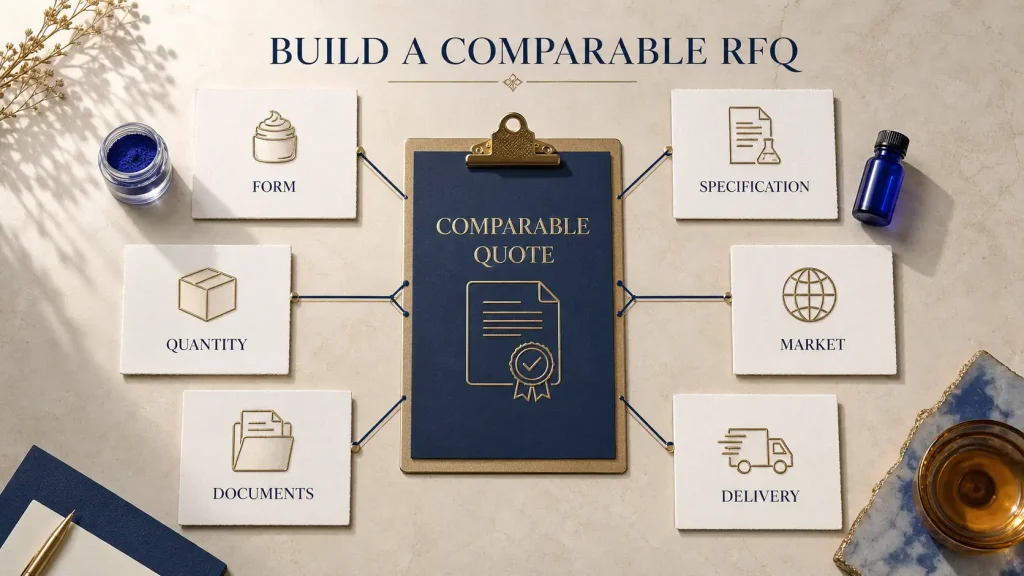
Copper Tripeptide-1 price is determined by more than the ingredient name. A comparable supplier quote must define the material form, specification basis, active or peptide content, order quantity, document and testing scope, packaging, delivery terms and technical service. A powder quoted per gram and a diluted solution quoted per kilogram are not directly comparable. Ask every supplier to quote the same requirement and calculate cost on an active-equivalent and landed-cost basis before deciding.
Introduction
Buyers often ask for a Copper Tripeptide-1 price before defining what they intend to buy. That produces a number quickly, but not necessarily a usable comparison. Copper Tripeptide-1 may be offered as a blue powder with an HPLC purity specification or as a blue solution with a stated peptide-content level, carrier system and package size. These formats create different formulation work, storage needs, shipping weights and quality-document requirements.
The useful question is therefore not “Which supplier has the lowest number?” It is “Which quotation gives the required material, evidence and delivery conditions at the most defensible total cost?” This article focuses on cosmetic-ingredient procurement. It does not discuss injectable products, reconstitution for medical use or consumer retail serum pricing.
Start by Defining the Quote Basis
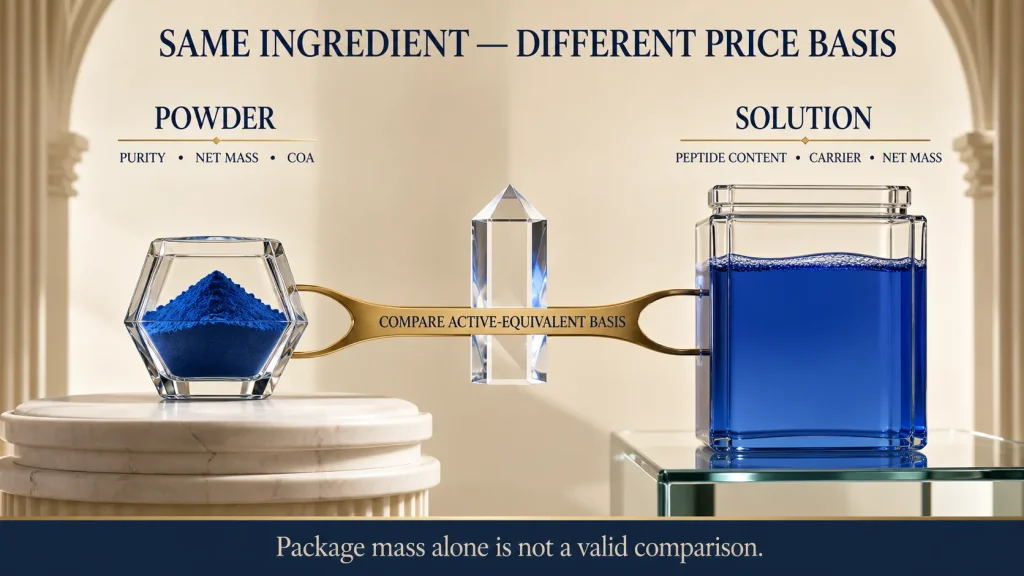
Before comparing quotations, place the specification beside the price. The current Skinkind Cosmetics product page describes powder options with HPLC purity of at least 95% or at least 98%, while solution options are described by customizable peptide content from 1,000 ppm to 50,000 ppm. These are different commercial bases. “One kilogram” does not represent the same amount of peptide in every offer.[1]
| Quote Basis | What the Buyer Must Confirm | Why It Changes Comparability |
| Powder | INCI identity, HPLC purity specification, moisture or counterion basis where relevant, net mass and batch COA | The quoted mass is concentrated material, but analytical bases and handling requirements may differ |
| Solution | Peptide content in ppm or percent, complete carrier/preservative composition, density if needed, net mass and batch COA | Most of the shipped mass may be carrier; the active-equivalent quantity depends on the declared content |
| Custom preparation | Target concentration, solvent or carrier, preservative status, package, batch size and acceptance criteria | Development work, nonstandard testing, setup and smaller production scale may be included |
Six Factors That Commonly Change a Supplier Quote
1. Material Form and Composition
Powder usually concentrates more peptide into less shipping mass, but it may require controlled weighing, dissolution and stronger handling discipline at the manufacturing site. A solution can simplify dosing and dispersion, yet its price per kilogram includes water or another carrier, any preservation system, packaging and the supplier’s preparation work. The lower-looking unit price is not automatically the lower formula cost.
2. Specification and Release Testing
A higher numerical purity specification can require tighter synthesis, purification and release controls, but the highest available number is not automatically the best purchasing decision. The specification must match the product concept, analytical method, risk assessment and finished-formula validation plan. Buyers should also distinguish a headline HPLC purity value from identity, peptide content, moisture, residuals, microbiological quality and other batch-specific acceptance items.
3. Quantity, Pack Size, and Production Scale
Small samples and development quantities often carry more packaging, handling, testing and order-processing cost per unit. Larger orders may spread some fixed costs across more material, but only if the specification, packaging and production plan remain unchanged. Public marketplace listings sometimes display lower per-kilogram prices at larger pack sizes, but those tiers belong to the exact listed formulation and should not be treated as a universal GHK-Cu price curve.[5]
4. Documentation and Market Requirements
COA, TDS and SDS are basic parts of many ingredient reviews, but a project may also require traceability records, origin information, allergen or animal-origin statements, residual-solvent information, microbiological data, method details, regulatory support or market-specific declarations. ISO 22716 covers quality aspects of production, control, storage and shipment, while regulatory guidance emphasizes supplier approval, material acceptance criteria, records and traceability.[2][3][4] The quotation should state which documents are included, batch-specific or subject to separate work.
5. Packaging, Storage, Shipping, and Incoterms
Container size, light and moisture protection, secondary packaging, temperature expectations, route, insurance and delivery term all affect landed cost. The Skinkind Cosmetics page, for example, describes moisture-protected express air freight for powder and long-term 2-8°C storage for solution.[1] A buyer should confirm the exact shipping configuration for the offered batch rather than infer freight or storage cost from a generic product description.
6. Customization and Technical Service
A standard stock item and a customized solution are not the same service. Concentration adjustment, carrier selection, preservative changes, special packaging, nonstandard analytical work, formula guidance, sample coordination and post-delivery troubleshooting may add cost, reduce downstream development work or both. Request a separated description when service scope is material to the quotation.

Compare Active-Equivalent Cost and Landed Cost
For a solution quoted in ppm by mass, a simple first conversion is:
Nominal active-equivalent grams = solution mass in kilograms × peptide content in ppm ÷ 1,000
A 1 kg solution declared at 10,000 ppm therefore contains a nominal 10 g of peptide on that stated basis. This arithmetic does not replace a COA, correct for analytical uncertainty or prove finished-formula performance. It simply prevents a kilogram of dilute solution from being compared directly with a kilogram of powder.
Landed cost should then add the items required to receive and use the material: packaging, freight, insurance, duties or taxes where applicable, customs or broker charges, temperature-control measures, incoming testing, rejected-batch risk, internal handling and any development work created or avoided by the selected format.
Send a Quote Request That Suppliers Can Answer Accurately
- Specify the product. State Copper Tripeptide-1 / GHK-Cu, intended cosmetic use and whether powder or solution is required.
- Define the specification. For powder, state the requested HPLC purity and any other required release items. For solution, state target peptide content, carrier or solvent preferences, preservative requirements and package size.
- State the project stage and quantity. Separate sample, pilot and commercial forecasts. Do not present an uncertain annual estimate as a firm order.
- Identify the market and documents. List destination market, required COA, TDS, SDS, traceability and any project-specific statements or test data.
- Define delivery requirements. Give destination country or city, requested delivery term, preferred shipment timing and any temperature or packaging constraints.
- Ask for commercial clarity. Request unit price, currency, quotation validity, MOQ, lead time, pack size, payment terms, included services and exclusions.
Frequently Asked Questions
1. How much does Copper Tripeptide-1 cost?
There is no reliable universal price without a defined offer. The answer changes with powder or solution form, purity or peptide-content basis, quantity, packaging, documentation, delivery term and customization. Request a current Copper Tripeptide-1 supplier quote for the exact project rather than relying on a retail vial, marketplace listing or old benchmark.
2. Why can Copper Tripeptide-1 solution price look lower than copper peptide powder price?
A solution price is normally quoted on the full solution mass, which includes the carrier and possibly preservatives. Powder concentrates much more peptide into the quoted mass. Convert both offers to the same active-equivalent basis, then add handling and landed costs before comparing Copper Tripeptide-1 solution price with copper peptide powder price.
3. Does a higher HPLC purity always provide better value?
Not automatically. A higher specification may be appropriate for some projects, but value depends on whether the analytical basis, other acceptance criteria and finished-formula needs justify it. Compare the complete specification and batch documentation, not one headline percentage.
4. Does a larger order always reduce total cost?
The unit price may decrease when fixed costs are spread across more material, but total inventory, storage, expiry, cash-flow and change-control risk can increase. Match cosmetic peptide MOQ and order size to the development stage, forecast confidence and usable shelf-life window.
5. What information should I send for a comparable GHK-Cu price quote?
Send the requested form, specification or concentration, application, target market, sample and forecast quantity, package preference, required documents, destination and desired timing. This lets suppliers quote the same scope and helps the buyer compare total value rather than unrelated numbers.
CTA
If your team is ready to request a Copper Tripeptide-1 price, send Skinkind Cosmetics the intended format, specification, application, destination market, sample or commercial quantity, required documents and delivery location. Genopep can then prepare a project-specific quotation for available powder or customizable solution options and clarify the included packaging, lead time and technical-service scope.
Review Copper Tripeptide-1 formats and request a project-specific quote
References
1. Skinkind Cosmetics / GENOPEP. Copper Tripeptide-1 (CAS: 49557-75-7) Product Information: powder purity options, solution peptide-content range, packaging and storage. Product page
2. International Organization for Standardization. ISO 22716:2007 Cosmetics – Good Manufacturing Practices (GMP) – Guidelines on Good Manufacturing Practices. ISO record
3. Health Canada. Good Manufacturing Practices (GMPs) for Cosmetic Products: raw-material control, testing, records, storage and distribution considerations. Government guidance
4. Health Products Regulatory Authority. Guide to Cosmetic Products for Responsible Persons: supplier approval, material acceptance criteria, traceability, storage and documentation. HPRA guide/adv-g0010-guide-to-cosmetic-products-for-responsible-persons-v7-changes-tracked.pdf)
5. CM Studio+. SpecPed GHK-Cu 1.0% Copper Peptide Solution marketplace listing: composition, documentation and pack-size pricing example. Accessed August 2026. Marketplace listing