Professional Cosmetics Peptide Supplier | GENOPEP



The Synergistic Double-Lock: Pairing Pentapeptide-18 and Acetyl Hexapeptide-8 for Expression-Line Care
The Concept of Multi-Targeting Expression-Line Pathways
In professional cosmetic chemistry, single-active products can reach a communication and performance plateau. When an age-care formula relies on one pathway only, the visible result depends on the evidence behind that active, the finished formula, the user’s skin condition, and the natural limits of a single mechanism story. For expression-line care, a single peptide can support a clear hero-ingredient message, but it may not fully explain the layered biology behind repeated facial movement, surface texture, skin comfort, and the appearance of deeper-looking lines.
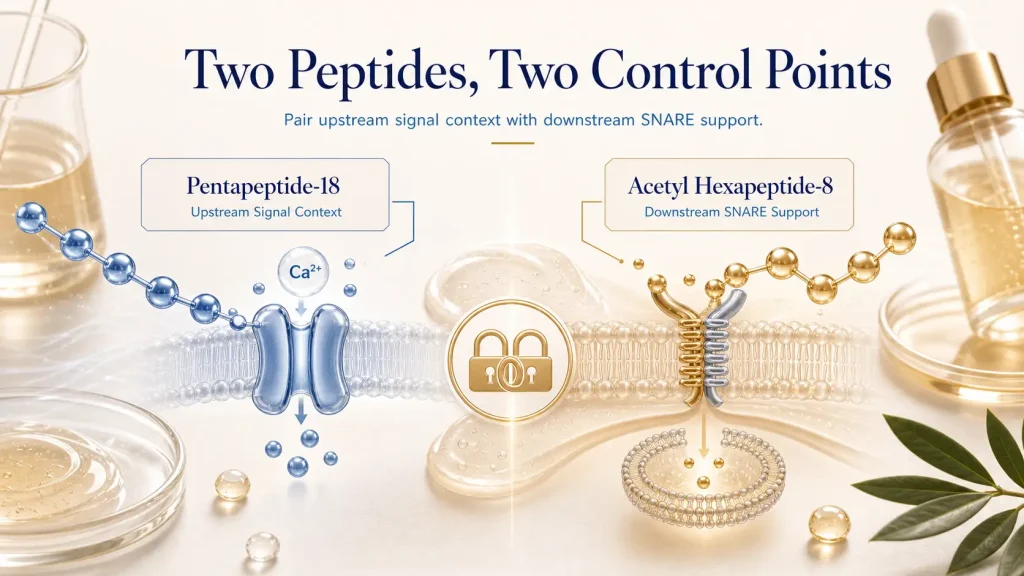
This is why modern neuropeptide skincare often uses a complementary matrix strategy. Instead of pushing one mechanism too hard, formulators can pair ingredients that sit in different parts of the expression-line story. Pentapeptide-18 is commonly discussed in relation to upstream enkephalin-inspired signaling and calcium-entry context. Acetyl Hexapeptide-8, better known as Argireline, is commonly discussed in relation to downstream SNARE-complex support. Together, they create a useful double-lock narrative for smoother-looking expression areas without turning the article into a drug-like neuromuscular claim.
Unpacking the Pentapeptide-18 and Argireline Synergy Matrix
To use the Pentapeptide-18 and Argireline synergy responsibly, the article should contrast their complementary mechanism contexts rather than claim that a cosmetic product shuts down neurotransmission. Acetyl Hexapeptide-8 is a synthetic hexapeptide associated with Argireline positioning. It is commonly described as a SNAP-25-inspired peptide, which gives formulators a downstream story connected to the SNARE complex and vesicle-fusion background. In public cosmetic wording, the safer endpoint is softer-looking expression lines and smoother-looking expression areas.
Pentapeptide-18 gives the pairing a different upstream angle. It is often discussed in relation to enkephalin-inspired receptor signaling and calcium-entry context. This does not mean a finished cream should claim to control nerve function. It means the ingredient can help brands tell a more sophisticated mechanism story around expression-line appearance, especially when the formula also includes moisturizers, barrier-support ingredients, and sensory agents that improve the overall skin feel.
When these two peptides are formulated together, the practical value is a clearer multi-peptide matrix with two complementary roles: upstream signal context and downstream SNARE support. If a supplier or finished-product study reports numerical improvements, those numbers should be used only when the source, test design, concentration, duration, and product base are available. Without that file, the article should avoid unsupported percentages and focus on responsible appearance-based claims.

From Clinical Numbers to a Responsible Claim File
Product developers often want a simple comparison between a single peptide and a combined matrix. That comparison can be useful, but it must be handled carefully. A 28-day in-vivo study, a supplier efficacy panel, and an internal finished-product test are not the same type of evidence. Before using a number such as wrinkle-depth reduction, the brand should confirm the active level, test method, subject number, measurement instrument, base formula, and whether the result belongs to a raw material, a prototype, or the final commercial product.
For an independent-site article, the stronger public angle is: Pentapeptide-18 and Acetyl Hexapeptide-8 can be positioned as a complementary neuropeptide pairing for smoother-looking expression areas, more refined-looking skin texture, and mature-skin formulas that need a modern multi-peptide story. The scientific background supports the formulation rationale; the finished product evidence supports the commercial claim.
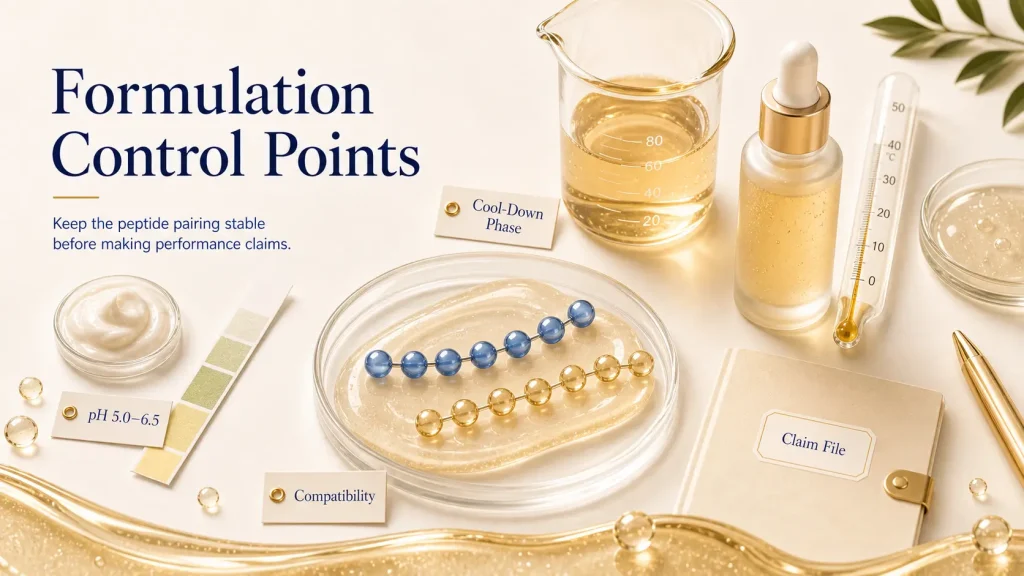
Formulation Control Points for a Double-Peptide System
For cosmetic chemists incorporating this pairing into a commercial formula, stability and compatibility are as important as mechanism storytelling. Both peptides are typically handled as water-soluble peptide ingredients, so the formula brief should define the water phase, addition stage, mixing process, preservative system, and exposure to heat. A conservative development route is to add peptide components during the cool-down phase, avoiding unnecessary high-temperature processing unless the supplier’s documentation supports it.
The target pH should also be selected according to the supplier specification and final formula needs. Many peptide systems are developed in mildly acidic to near-neutral skincare ranges, but the exact window should be verified with the raw material documentation and real-time stability testing. Formulators should also screen compatibility with strong oxidizing actives, high-electrolyte systems, aggressive acids, metal salts, incompatible thickeners, and packaging materials that may change color, clarity, viscosity, odor, or active integrity over time.
For brands developing serums, eye creams, ampoules, or mature-skin creams, the double-lock story becomes strongest when paired with practical evidence: peptide identity, recommended use level, stability data, compatibility notes, sensory evaluation, and finished-product claim support. Genopep can support peptide selection and formulation discussion for Pentapeptide-18, Acetyl Hexapeptide-8, and multi-peptide expression-line concepts. Request a quote with your target product format, claim direction, and market requirements.
References
Blanes-Mira, C., Clemente, J., Jodas, G., Gil, A., Fernández-Ballester, G., Ponsati, B., Gutierrez, L., Pérez-Payá, E., & Ferrer-Montiel, A. (2002). A synthetic hexapeptide (Argireline) with anti-wrinkle activity. International Journal of Cosmetic Science, 24(5), 303-310. https://doi.org/10.1046/j.1467-2494.2002.00153.x
Schagen, S. K. (2017). Topical peptide treatments with effective anti-aging results. Cosmetics, 4(2), 16. https://doi.org/10.3390/cosmetics4020016
Südhof, T. C. (2013). Neurotransmitter release: the last millisecond in the life of a synaptic vesicle. Science, 342(6164), 1324-1333. https://doi.org/10.1126/science.1233232
Tedford, H. W., & Zamponi, G. W. (2006). Direct G protein modulation of Cav2 calcium channels. Pharmacological Reviews, 58(4), 837-862. https://doi.org/10.1124/pr.58.4.11
Reference note: exact clinical percentages, use levels, pH windows, and processing conditions should be taken from supplier documentation or finished-product testing before being used as public claims.