Professional Cosmetics Peptide Supplier | GENOPEP



Where Can You Use Acetyl Hexapeptide-8 on the Face? Target Areas and Formulation Considerations
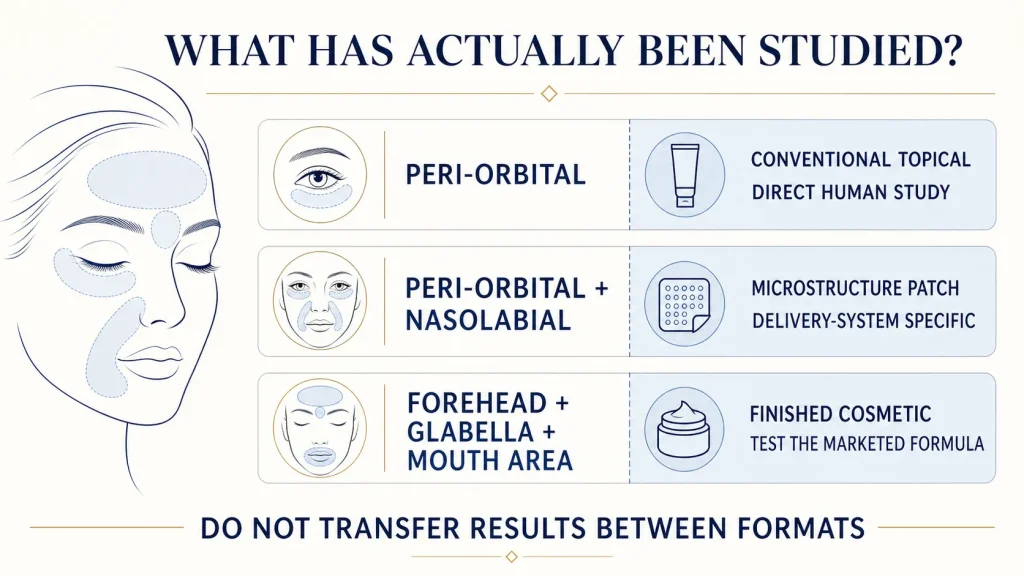
Where can you use Argireline on the face? Published Acetyl Hexapeptide-8 evidence most directly covers peri-orbital wrinkles, while a microstructure patch study also evaluated nasolabial folds. Forehead, glabellar, mouth-area and full-face use require a finished-product rationale and appropriate testing. The cosmetic raw material should not be applied directly to skin.
Introduction
The question “where can you use Argireline on the face” appears simple, but it contains three different decisions: where facial movement creates visible lines, where Acetyl Hexapeptide-8 has actually been studied, and where a finished cosmetic has been designed and assessed for use. These areas overlap only partly. A scientifically responsible product brief should not turn a familiar ingredient name into permission to use every material on every part of the face.
Acetyl Hexapeptide-8 is a cosmetic peptide associated with expression-line concepts. Skinkind Cosmetics lists it in powder and solution formats within the Genopep facial-care portfolio.[7] Those are raw-material options for formulators, not ready-to-use consumer products. Application area, use directions, preservative system, packaging and safety substantiation belong to the finished product.
Start With the Evidence Map, Not a Face Diagram
The strongest direct conventional-topical evidence is peri-orbital. A 2013 randomized placebo-controlled study enrolled 60 Chinese subjects and applied Argireline or placebo to peri-orbital wrinkles twice daily for four weeks. The study used subjective grading and silicone-replica roughness analysis and reported improvement in the tested Argireline group.[1] This supports the peri-orbital area as a studied application site for that formula and protocol; it does not automatically validate every under-eye serum or every facial area.
A separate 2019 double-blind, randomized, controlled split-face study tested a dissolving cross-linked hyaluronic-acid microstructure patch on lateral peri-orbital wrinkles and nasolabial folds. The patch containing Acetyl Hexapeptide-8 was worn for four hours once weekly for 29 days.[2] This adds area-specific evidence, but its delivery system is materially different from an ordinary serum, cream or toner. Brands should not transfer patch results to a conventional topical format without new substantiation.
Can You Put Argireline Under the Eyes?
“Argireline under eyes” is a high-intent search phrase, but the useful answer is not simply yes or no. The peri-orbital area includes skin around the eye; it is not the same as the ocular surface, lash line or inside of the eyelid. A peptide eye serum formulation should be intentionally designed for its labeled area, with suitable ingredients, preservation, packaging, directions and tolerance assessment. FDA consumer guidance likewise advises using products near the eyes only when they are intended for that use.[6]
The ingredient safety conclusion does not replace finished-product assessment. The Expert Panel for Cosmetic Ingredient Safety concluded that Acetyl Hexapeptide-8 Amide was safe in cosmetics at concentrations up to 0.005% in the practices reviewed; available data were insufficient to determine safety above that concentration.[5] Formulators must calculate actual active concentration rather than confuse the percentage of a diluted supplier solution with the percentage of pure peptide.
Forehead, Glabella and Crow’s-Feet Concepts
The forehead, glabella and lateral eye area are familiar expression line areas because they move repeatedly during raising the brows, frowning and squinting. They can therefore be reasonable targets for a targeted peptide serum concept. However, biological plausibility and consumer familiarity are not the same as area-specific clinical proof. The published conventional-topical trial cited above directly tested peri-orbital wrinkles, not a universal forehead-and-glabella claim.[1]
For a brand, the practical choice is to define the claim first. If the intended claim is “helps improve the appearance of forehead expression lines,” the test should recruit appropriate subjects, standardize facial expression and imaging, define the forehead measurement zone and evaluate the marketed formula in its final package. A generic “facial anti-wrinkle” test may be too broad to support a precise area claim.
Can You Use Argireline Around the Mouth?
Argireline around mouth is often discussed as if all visible folds in that area share one cause. They do not. Fine lines linked to lip movement, lines at the oral commissures and the nasolabial fold have different geometry and may reflect different combinations of movement, hydration, photodamage, tissue volume and structural change. A topical expression-line concept should not promise to correct every type of mouth-area fold.
The microstructure-patch study provides a useful precedent because it included nasolabial folds, but the evidence belongs to the tested patch architecture, once-weekly schedule and 29-day protocol.[2] For an ordinary targeted peptide serum, the mouth area remains a formulation-and-testing question. Product directions should also avoid unintended contact with the lips or oral mucosa unless that exposure has been considered in the safety assessment.
Targeted Serum or Full-Face Product?
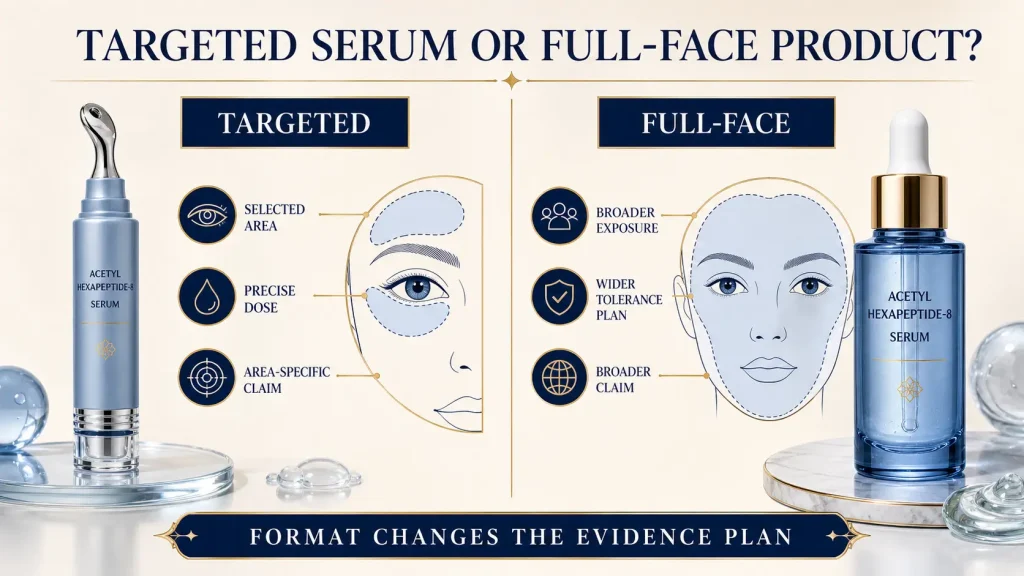
A targeted product can direct a small amount to selected expression line areas and make the intended use easier to standardize. A full-face product may be more convenient and can combine hydration, emollience and broader texture benefits, but it also increases the application area and may expose more sensitive zones. Neither format is inherently superior; the appropriate choice depends on claim, dose, texture, packaging, consumer instructions and the evidence plan.
Skin delivery is another reason not to answer area questions with a face chart alone. In a 2015 in-vitro study of an oil-in-water cosmetic formulation, most applied Acetyl Hexapeptide-8 was recovered in surface washes; 0.22% was found in human stratum corneum, 0.01% in viable epidermis and none in dermis or receptor fluid under the study conditions.[3] A separate porcine-skin study found that emulsion architecture affected delivery.[4] Area selection therefore cannot be separated from vehicle design.
Where Does Argireline Fit in a Skincare Routine?
An Argireline skincare routine applies only to a finished cosmetic, not to peptide powder or an unpreserved supplier concentrate. Consumers should follow the product label. For a conventional leave-on serum, a common practical sequence is cleansing, a lighter serum, moisturizer and daytime sunscreen, but texture and product instructions can change the order. “Thin to thick” is a usability convention, not a chemical law.
There is no robust evidence that Acetyl Hexapeptide-8 itself creates a universal prohibition against hyaluronic acid, vitamin C or retinoids. Hyaluronic acid can coexist with the peptide in a specific tested delivery system, as the microstructure-patch study illustrates, but that does not prove every retail combination is compatible.[2] Low-pH formulas, oxidizing environments, preservation systems, processing temperature and packaging may influence peptide stability or skin tolerance. Brands should use supplier documentation, compatibility screening and stability testing rather than publish a generic “never mix” list.
A Defensible Area-Selection Workflow for Brands
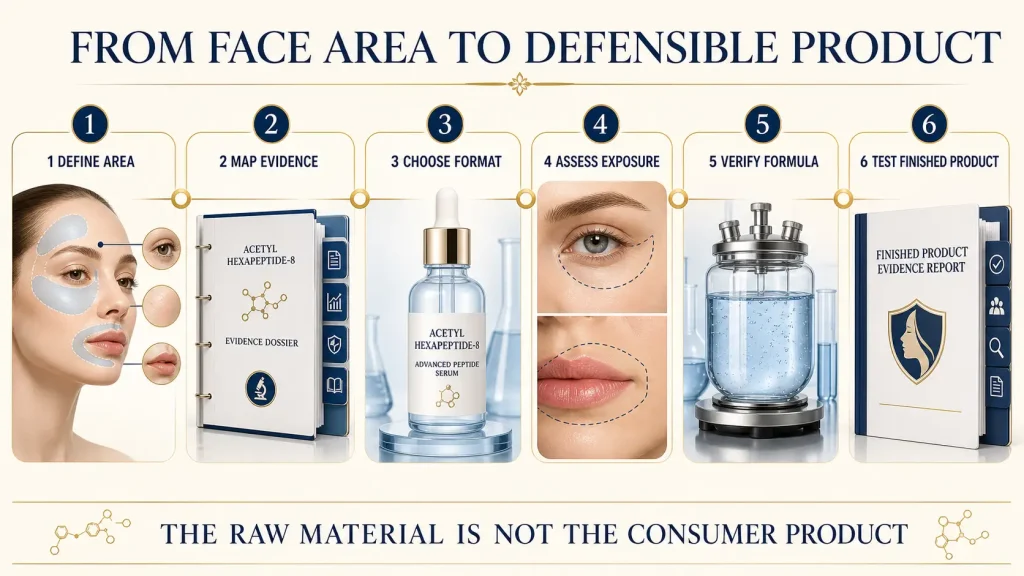
When a development team asks where can you use Argireline on the face, the answer should become a documented product-development sequence:
1. Define the visible concern and exact anatomical application zone.
2. Separate directly studied areas from concept-led extensions.
3. Select the finished format and calculate the actual active-equivalent dose.
4. Review eye, lip and mucosal-contact risks created by the directions for use.
5. Confirm compatibility, preservation, stability and packaging performance.
6. Test the marketed formula on the intended area using relevant endpoints.
FDA states that the manufacturer or distributor is responsible for ensuring that a marketed cosmetic is safe under labeled or customary use, and that ingredient or finished-product testing may be needed.[6] This principle is especially relevant when the instructions move a product closer to the eye or mouth.
Conclusion
The evidence-based answer to “where can you use Argireline on the face” begins with peri-orbital wrinkles, because that area has direct conventional-topical human research. Nasolabial folds have also been studied in a specialized dissolving microstructure patch. Forehead, glabella, mouth-area and full-face concepts may be reasonable product directions, but they require their own finished-formula rationale and substantiation.
For brands and formulators, Acetyl Hexapeptide-8 target areas are not merely dots on a face. They determine dose, applicator, tolerance requirements, study photography, measurement zones, directions and claims. Skinkind Cosmetics can provide powder or solution options for formulation work, while the marketed product must establish where and how it should actually be used.
Frequently Asked Questions
Where does Argireline fit in my skincare routine?
Use only a finished product according to its label. A light leave-on serum is commonly applied after cleansing and before moisturizer, but the manufacturer’s directions and the complete routine determine the appropriate order. Raw Acetyl Hexapeptide-8 powder or supplier concentrate is not a consumer serum.
Can I put Argireline under my eyes?
Use a finished product only if it is intended for the peri-orbital area, and keep it out of the eyes and away from unintended mucosal contact. Published research has evaluated a specific Argireline formula on peri-orbital wrinkles, but that does not validate every product for eye-area use.
Can you use Argireline around your mouth?
A finished product may be designed for mouth-area expression lines, but lip lines, oral-commissure lines and nasolabial folds are not identical concerns. Directions and safety assessment should address possible lip or mucosal contact, and area-specific efficacy claims need matching evidence.
What can I layer Argireline with?
There is no universal list that applies to every finished product. Hyaluronic acid, moisturizers, vitamin C products and retinoids differ widely in pH, vehicle and irritation potential. Follow each label and reduce complexity if irritation occurs. Formulators should verify compatibility and stability in the actual formula.
Should I use moisturizer after Argireline?
If the finished Argireline product is a light serum, a moisturizer may follow to support comfort and reduce water loss. If it is already a cream or rich emulsion, a separate moisturizer may be unnecessary. The product format and the user’s skin needs control the answer.
CTA
Explore Acetyl Hexapeptide-8 powder and solution formats from Skinkind Cosmetics and request the composition, active-content and formulation guidance needed to develop a targeted or full-face expression-line product.
- Dynamic Wrinkles vs. Static Wrinkles: What Is the Difference?
- How Does Acetyl Hexapeptide-8 Work?
- How Long Does Acetyl Hexapeptide-8 Take to Work?
- Is Acetyl Hexapeptide-8 Safe in Cosmetics?
References
[1] Wang Y, Wang M, Xiao S, et al. The anti-wrinkle efficacy of argireline, a synthetic hexapeptide, in Chinese subjects: a randomized, placebo-controlled study. American Journal of Clinical Dermatology. 2013;14(2):147-153. PMID record
[2] An JH, Lee HJ, Yoon MS, Kim DH. Anti-Wrinkle Efficacy of Cross-Linked Hyaluronic Acid-Based Microneedle Patch with Acetyl Hexapeptide-8 and Epidermal Growth Factor on Korean Skin. Annals of Dermatology. 2019;31(3):263-271. Full-text record
[3] Kraeling MEK, Zhou W, Wang P, Ogunsola OA. In vitro skin penetration of acetyl hexapeptide-8 from a cosmetic formulation. Cutaneous and Ocular Toxicology. 2015;34(1):46-52. PMID record
[4] Hoppel M, Reznicek G, Kahlig H, et al. Topical delivery of acetyl hexapeptide-8 from different emulsions: influence of emulsion composition and internal structure. European Journal of Pharmaceutical Sciences. 2015;68:27-35. DOI record
[5] Johnson W Jr, Bergfeld WF, Belsito DV, et al. Safety Assessment of Acetyl Hexapeptide-8 Amide as Used in Cosmetics. International Journal of Toxicology. 2025;44(2_suppl):54S-63S. PMID record
[6] U.S. Food and Drug Administration. Product Testing of Cosmetics; Eye Cosmetic Safety. Product testing guidance and eye cosmetic safety guidance
[7] Skinkind Cosmetics. Acetyl Hexapeptide-8, CAS 616204-22-9, Anti-Wrinkle and Firming Peptides. Product page