Professional Cosmetics Peptide Supplier | GENOPEP



What Causes Skin to Lose Firmness? Collagen, Elastin, and the Visible Signs of Aging
Skin loses firmness when aging and cumulative environmental exposure reduce collagen production, fragment existing collagen, and alter the elastic-fiber network that helps skin recover after stretching. Dehydration can make lines and laxity look more noticeable, but it is not the same as structural loss of firmness.
Introduction
“Loss of firmness” sounds like one concern, but consumers may use the phrase for several different observations: skin that feels less springy, facial contours that look less defined, fine lines that remain after expression, or a dry surface that no longer appears plump. These changes can overlap, yet they do not have one cause or one cosmetic solution.
For skincare brands and formulators, understanding what causes skin to lose firmness—and distinguishing it from the broader loss of skin elasticity—is therefore more useful than beginning with a fashionable ingredient. A sound product brief first separates structural support, elastic recoil, surface hydration and the wider anatomy that shapes facial appearance. It can then define a realistic cosmetic target such as firmer-looking skin, improved visible elasticity or smoother-looking texture.
What Does Skin Firmness Actually Mean?
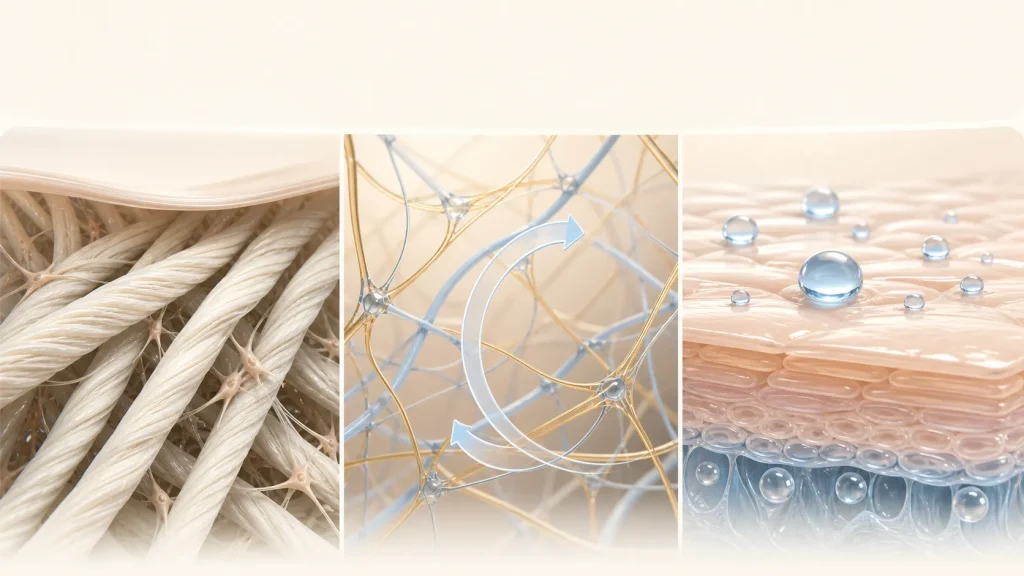
Skin firmness and elasticity are related but not identical outcomes, and neither is the name of a single molecule. In the dermis, collagen-rich extracellular matrix provides much of the tissue’s tensile support. The elastic-fiber system helps stretched skin return toward its original shape. Glycosaminoglycans and water influence tissue hydration, while the epidermis and stratum corneum affect surface smoothness, softness and the visibility of fine lines.
These systems work together, but they are not interchangeable. More surface water can make skin look temporarily smoother without rebuilding the dermal matrix. A change in elastic recoil is not automatically proof of greater collagen content. Likewise, visible facial laxity or sagging skin may also reflect changes in fat compartments, ligaments, muscle or skeletal support that a topical cosmetic cannot replace.
This distinction protects both scientific accuracy and claim quality. A moisturizer may legitimately target hydration and plump-looking skin. A firmness concept needs a broader formula and a validation plan matched to the exact wording used on the finished product.
Why Does Skin Lose Firmness Over Time?
1. Intrinsic Aging Changes Collagen Production and Support
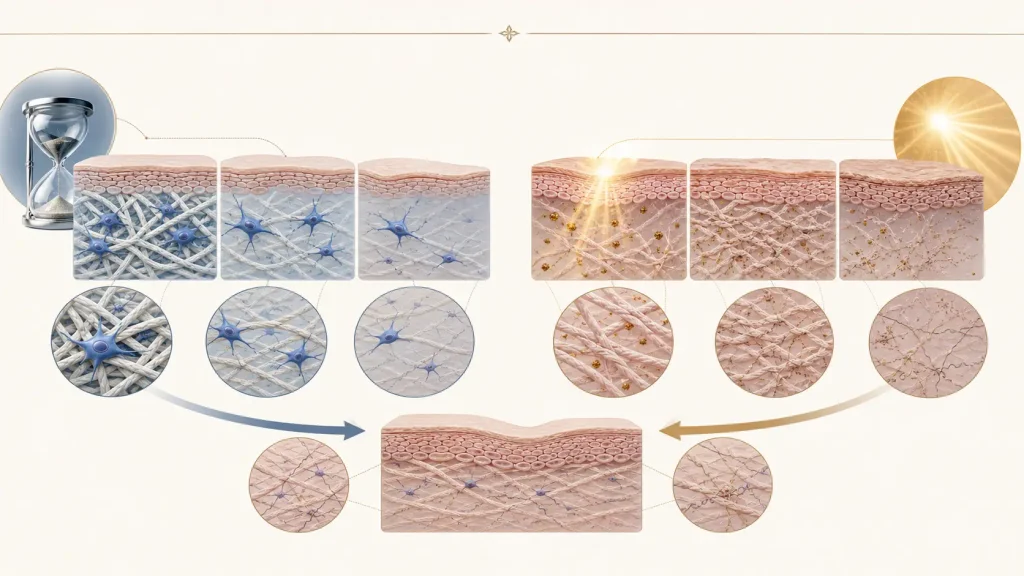
Collagen is continuously maintained through a balance of synthesis, organization and breakdown. In a human skin study, Varani and colleagues found that reduced collagen synthesis in chronologically aged skin reflected both age-related changes in fibroblast function and weaker mechanical stimulation from a fragmented surrounding matrix.[1] This creates an important feedback problem: fibroblasts work best when they are mechanically connected to an intact collagen network, but fragmentation reduces that tension and can further weaken collagen production.
The visible result is not simply “less collagen.” The matrix can become less organized and less able to distribute mechanical forces. Skin may then look thinner, less supported and more prone to persistent lines. This is why ingredient stories based only on “boosting collagen” often oversimplify the biology.
2. Elastic-Fiber Architecture Changes With Age
Collagen and elastin have different jobs. Collagen resists stretching and supports tissue shape; the elastic-fiber network helps skin recoil after deformation. That network includes elastin, fibrillin-rich microfibrils and associated proteins. Human biopsy research has reported an age- and photoexposure-related decline in microfibril-associated glycoprotein-1, a component involved in elastic-fiber assembly and structural organization.[4]
For cosmetic communication, the practical lesson is restraint. “Supports the appearance of elasticity” is a defensible direction when the finished formula has suitable evidence. “Rebuilds elastin” or “restores the youthful elastic network” implies a much stronger structural outcome and should not be used without direct, product-specific substantiation.
3. UV Exposure Accelerates Matrix Damage
Intrinsic aging happens with time, but photoaging adds another pathway. Human in-vivo research showed that UVB exposure can induce matrix-degrading metalloproteinases in skin within hours.[2] Repeated episodes of increased breakdown, combined with reduced collagen production, can contribute to cumulative disorganization of the dermal matrix.
Research comparing photodamaged forearm skin with subject-matched, sun-protected underarm skin found more fragmented and disorganized collagen fibrils together with abnormal elastotic material in the photodamaged dermis.[3] This helps explain why long-term sun exposure is associated not only with lines and uneven tone, but also with a leathery or less resilient appearance.
The American Academy of Dermatology therefore places daily sun protection at the foundation of premature-aging prevention. Broad-spectrum sunscreen, protective clothing and shade do not “tighten” skin overnight, but they address one of the most important modifiable drivers of future photoaging and visible skin aging.[5]
4. Dehydration Can Magnify the Appearance of Laxity
When the stratum corneum is dry, its surface can look rougher and fine lines may appear more obvious. Moisturization can improve softness and create a more conditioned, plump-looking surface. That can be valuable and visible, but it should be described as hydration and surface improvement rather than deep tissue tightening.
This difference matters in before-and-after assessment. A rapid change after one application is more likely to reflect hydration, film formation, light reflection or temporary sensory effects than newly built collagen or elastic fibers. Structural claims require longer, well-controlled finished-product testing.
Collagen vs Elastin: Different Roles in Firmness and Elasticity
| Structure or Factor | Main Role | What Change May Look Like | Appropriate Cosmetic Language |
| Collagen-rich matrix | Tensile support and force distribution | Thinner-looking, less supported skin and more persistent lines | Supports firmer-looking skin; improves the appearance of firmness |
| Elastic-fiber network | Recoil after stretching | Reduced visible bounce and slower-looking recovery | Supports the appearance of elasticity or resilience |
| Hydration and barrier condition | Surface softness, smoothness and plump appearance | Dryness, roughness and more visible superficial lines | Hydrates, plumps and smooths the appearance of dry lines |
| Wider facial support | Volume and contour from tissues below the skin | Deeper laxity or contour change | Do not imply that a topical cosmetic replaces lost volume or lifts deep tissue |
Can Skin Regain Firmness?
Skin can look better hydrated, smoother and, in some cases, firmer or more elastic after a consistent routine or a properly tested cosmetic product. That does not mean every age-related structural change has been reversed. The realistic answer depends on what the person calls “loss of firmness,” how it is measured and whether the main issue is surface dryness, dermal skin quality or deeper facial support.
A practical strategy has three parts. First, protect against avoidable future damage, especially cumulative UV exposure. Second, maintain hydration and barrier comfort so surface dryness does not exaggerate lines. Third, choose a finished formula whose active system, vehicle, packaging, stability and claim testing are aligned. No single raw material can substitute for this complete system.
What This Means for Skincare Product Development
For product teams, “firming” should be converted into a testable brief before ingredients are selected. Is the desired outcome immediate surface plumping, improved instrument-measured elasticity, a consumer-perceived firmer feel, smoother-looking texture, or a longer-term change in the visible appearance of firmness? Each objective suggests different formula architecture, study duration and claim wording.
A balanced formula may combine humectants for water binding, emollients and barrier-support ingredients for comfort, antioxidants or photoprotection-compatible design for environmental positioning, and carefully selected peptides for an appearance-led skin-quality story. The goal is not to stack the longest ingredient list. It is to assign each component a clear job and then validate the finished system.
This systems approach is also consistent with Genopep’s discussion of skin longevity and multi-peptide serum design: visible aging is multidimensional, so a credible formula should not make one peptide responsible for every outcome.

Where Copper Tripeptide-1 Fits in a Firmness-Support Concept
Copper Tripeptide-1, also known as GHK-Cu, can be considered as one component of an appearance-led firmness and skin-quality concept. Its presence in a raw-material research story does not by itself prove that a finished serum tightens skin, rebuilds elastin or performs better than retinol or vitamin C. Those conclusions would require evidence matched to the exact formula, dose, packaging, use conditions and claim.
For teams exploring the ingredient, Genopep’s GHK-Cu serum formulation notes provide a practical starting point. Skinkind Cosmetics lists Copper Tripeptide-1 (CAS 49557-75-7) in powder and customizable solution formats.[6] Product teams should request the current batch and format documentation, then evaluate compatibility, stability and finished-product claims within their own formulation.
Conclusion
What causes skin to lose firmness is not one isolated event. Chronological aging can reduce collagen production and alter fibroblast-matrix interaction. Collagen becomes fragmented, elastic-fiber architecture changes, and cumulative UV exposure accelerates disorganization of the dermal support network. Dryness can make the result look worse, but surface dehydration is not the same as structural laxity.
For skincare development, the strongest response is a precise brief: protect, hydrate, support visible skin quality and test the finished formula against a defined outcome. Copper peptides for skin firmness may be part of that strategy, but they should sit within a complete formulation and evidence plan rather than carry an unsupported promise alone.
CTA
Developing a skincare concept focused on the appearance of firmness and elasticity? Explore Skinkind Cosmetics Copper Tripeptide-1 (GHK-Cu) formats and contact Genopep to request current technical documents or discuss an evaluation sample.
Frequently Asked Questions
Can you regain elasticity in your skin?
When consumers ask, “can you regain skin elasticity?”, the responsible answer is that the appearance and measured behavior of skin can improve, but “regain” should not be interpreted as complete restoration of a young elastic-fiber network. Hydration can quickly improve surface plumpness, while consistent photoprotection helps reduce additional UV-related damage. A well-designed and properly tested cosmetic may support firmer- or more elastic-looking skin over time. The likely result depends on the starting condition, formula and measurement method.
Can saggy skin tighten back up?
It depends on what is causing the sagging and how severe it is. A topical product can improve hydration, smoothness and the appearance of firmness, but it cannot replace lost facial volume or reposition deep supporting tissues. When laxity is pronounced or changes rapidly, a dermatologist or qualified medical professional can help distinguish a cosmetic skin-quality concern from an issue that needs a different approach.
What is the fastest way to improve skin elasticity?
There is no responsible instant method for rebuilding the dermal elastic network. Moisturization may make dry skin look smoother and plumper relatively quickly, but longer-term firmness and elasticity goals require consistency. Daily sun protection, a tolerable routine and a finished product supported by relevant testing are more credible than a single “fastest” ingredient claim.
Is there a way to rebuild elastin?
The adult elastic-fiber network is structurally complex, and age- or UV-related changes should not be reduced to a promise that a cosmetic can simply “rebuild elastin.” Research can guide ingredient selection and formula hypotheses, but public claims should remain tied to demonstrated finished-product outcomes. “Supports the appearance of elasticity” is more appropriate than “reconstructs elastic fibers” unless direct product-specific evidence supports the stronger statement.
References
1. Varani J, Dame MK, Rittie L, et al. Decreased collagen production in chronologically aged skin: roles of age-dependent alteration in fibroblast function and defective mechanical stimulation. American Journal of Pathology. 2006;168(6):1861-1868. PubMed record
2. Fisher GJ, Datta SC, Talwar HS, et al. Molecular basis of sun-induced premature skin ageing and retinoid antagonism. Nature. 1996;379(6563):335-339. PubMed record
3. Shao Y, Qin Z, Wilks JA, et al. Physical properties of the photodamaged human skin dermis: rougher collagen surface and stiffer/harder mechanical properties. Experimental Dermatology. 2019;28(8):914-921. PubMed record
4. Zheng Q, Chen S, Chen Y, Lyga J, Wyborski R, Santhanam U. Investigation of age-related decline of microfibril-associated glycoprotein-1 in human skin through immunohistochemistry study. Clinical, Cosmetic and Investigational Dermatology. 2013;6:317-323. PubMed record
5. American Academy of Dermatology Association. 11 ways to reduce premature skin aging. Updated February 24, 2021. AAD guidance
6. Skinkind Cosmetics / Genopep. Copper Tripeptide-1 (CAS: 49557-75-7) Anti-Aging Peptides. Accessed August 4, 2026. Skinkind product page